Deutsch
 English
 Français
 Español
 Italiano
 Svenska
 Čeština
 Nederlands
 Русский
 Українська
 Polski



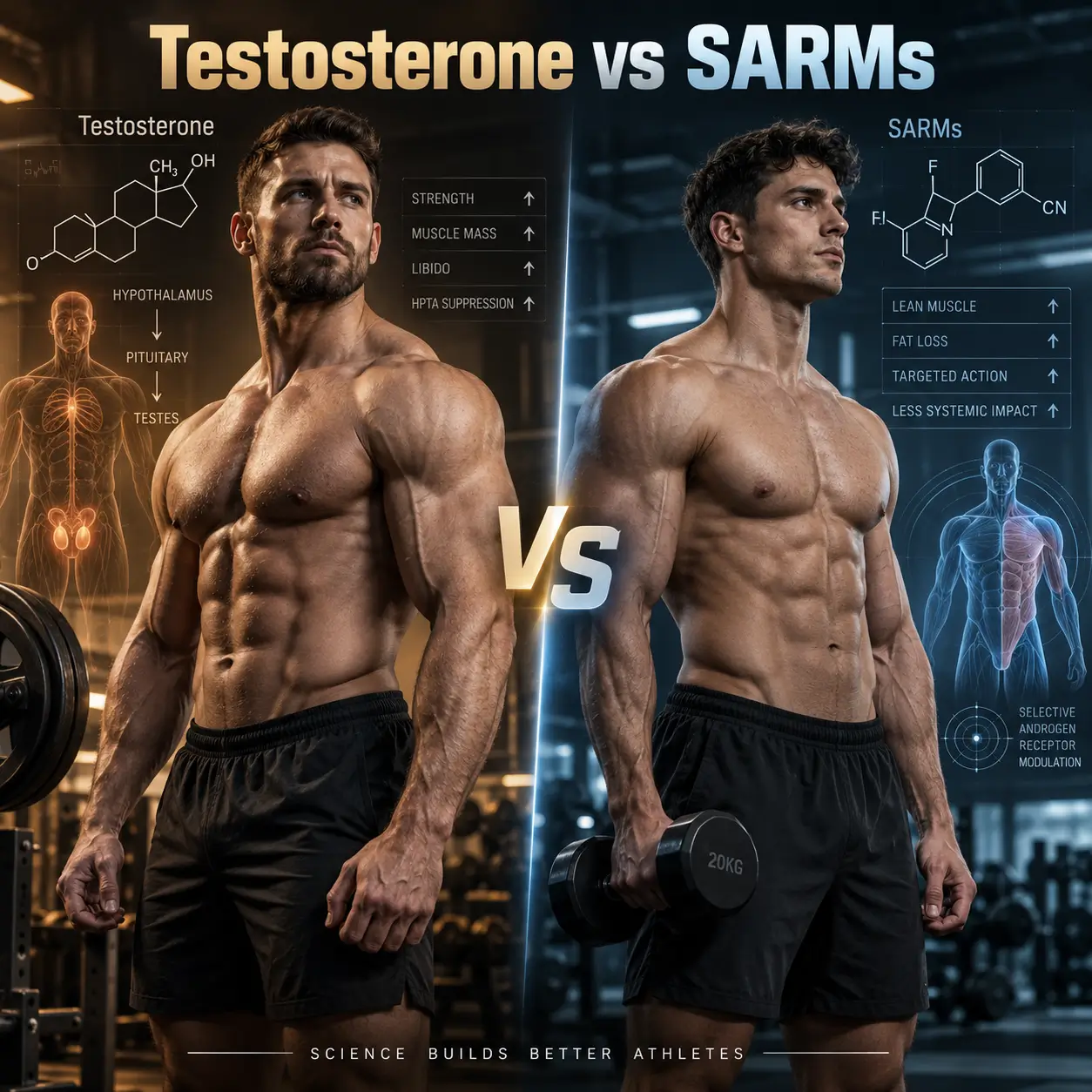
Since selective androgen receptor modulators first appeared, there has been ongoing debate over what is more effective for changing body composition: traditional androgens or more selective compounds. In bodybuilding, this question is especially relevant because athletes are often looking for a balance between gaining muscle, improving strength, and limiting the risk of side effects.
However, comparing Testosterone and SARMs only in terms of “which is stronger” is misleading. These compounds differ in their mechanisms of action, the amount of scientific evidence available, and how well their short- and long-term effects are understood. Testosterone has been used medically for decades and has been studied extensively, whereas most SARMs are still not approved for muscle gain or athletic use.
Comparing the anabolic activity of Testosterone and SARMs
Testosterone is a naturally occurring human androgen and a well-studied anabolic hormone. It binds to androgen receptors in many tissues, including skeletal muscle, and can stimulate processes associated with protein synthesis and increases in lean body mass.
Its effects are not limited to muscle tissue, however. Testosterone can be converted into estradiol through aromatase and into dihydrotestosterone through 5-alpha-reductase. As a result, its anabolic effects are accompanied by broader endocrine and androgenic effects throughout the body.
SARMs were developed with a different concept in mind. The goal was to activate androgen receptors more selectively in tissues such as muscle and bone while reducing activity in some other androgen-sensitive organs.
On paper, this type of tissue selectivity sounds attractive. In practice, the situation is more complicated. Individual SARMs can differ substantially from one another, and tissue selectivity does not mean an absence of systemic effects. Some compounds have shown an ability to increase lean body mass, but the amount of clinical evidence available is much smaller than it is for Testosterone.
There is another important point when interpreting SARM studies. Research often measures changes in lean body mass. This is not the same thing as pure skeletal muscle mass. Lean body mass includes water, organs, connective tissue, and other non-fat components of the body. An increase in lean body mass should therefore not automatically be interpreted as an equivalent increase in skeletal muscle.
Testosterone use in bodybuilding
Testosterone is used in bodybuilding primarily because of its pronounced and well-established anabolic effects. Exogenous Testosterone can increase lean body mass and strength, although the magnitude of these changes depends on many factors, including total exposure, nutrition, training stimulus, recovery, and individual response.
This is why phrases such as “guaranteed quality muscle gains” are not particularly accurate. Testosterone clearly has strong anabolic potential, but the final result is never determined by one compound alone.
Different Testosterone esters are commonly seen in sports pharmacology. They contain the same active hormone but differ in how quickly it is released and how long it remains active. These differences mainly affect pharmacokinetics rather than creating a fundamentally different anabolic mechanism.
Exogenous Testosterone also suppresses the body’s own hormonal axis and may affect hematocrit, blood lipids, blood pressure, reproductive function, and other physiological markers. Its effects therefore extend well beyond muscle tissue.
SARMs in bodybuilding and their effects on muscle growth
Interest in SARMs within bodybuilding developed largely from the idea of achieving anabolic effects while reducing the severity of some of the classic androgen-related side effects associated with traditional anabolic steroids.
These compounds are not steroids by chemical structure, but they interact with the same androgen receptor. Through this mechanism, they can influence processes involving both muscle and bone tissue.
Some SARMs associated with muscle gain have shown increases in lean body mass in clinical studies. Evidence for improvements in strength, physical function, and long-term safety is much less consistent.
SARMs should not be viewed as local compounds that act only in muscle tissue. They circulate systemically and can affect the hormonal axis, lipid levels, liver markers, and other physiological processes.
Most typical nonsteroidal SARMs also do not aromatize into estrogens. This distinguishes them from Testosterone, but it does not mean that changes in fluid balance or other adverse effects are impossible.
How SARMs affect natural Testosterone production
One of the most common misconceptions about SARMs is that they have little or no effect on the endocrine system. In reality, selective androgen receptor activity does not eliminate negative feedback.
When androgenic activity in the body increases, the hypothalamic-pituitary-gonadal axis may reduce its own stimulation of the testes. As a result, endogenous Testosterone production can decline.
The effect of SARMs on Testosterone depends on the specific compound, the duration of exposure, and the individual response. Even compounds described as relatively “mild” in bodybuilding circles can reduce natural Testosterone levels and alter LH and FSH.
For this reason, the claim that SARMs allow natural hormone production to remain “at maximum levels” does not reflect actual physiology.
Testosterone suppression with SARM use
The main mechanism behind hormonal suppression is negative feedback. The body interprets additional androgenic stimulation as a signal to reduce its own hormonal signaling and hormone production.
The degree of Testosterone suppression cannot be described in advance as universally mild or moderate. It can vary significantly between different SARMs and depends on the duration of exposure, the characteristics of the compound itself, and individual sensitivity.
Compared with conventional anabolic steroids, some SARMs may indeed show a different suppression profile. That does not mean they are automatically safer for the endocrine system.
Another important issue is that SARM products sold on the sports market do not always match their label claims. If the actual concentration differs from what is stated on the packaging, or if the product contains additional compounds, predicting the degree of hormonal suppression becomes even more difficult.
Recovery of Testosterone production after SARMs
After SARMs are discontinued, the hormonal axis may gradually recover, but there is no universal recovery timeline.
In one person, laboratory markers may return toward baseline relatively quickly, while in another, suppression may persist much longer. Recovery can be influenced by the specific compound, duration of exposure, degree of axis suppression, and the baseline condition of the endocrine system.
It is therefore not accurate to claim that normal Testosterone production after SARMs will always recover within a few weeks.
If symptoms of hypogonadism persist after discontinuation or laboratory markers remain abnormal, medical assessment is appropriate. Any decision regarding drug treatment, including Post Cycle Therapy (PCT), should be based on laboratory results and the individual’s condition rather than being treated as an automatic step after every period of SARM use.
Side effects, hormonal risks, and monitoring
SARMs are often marketed as a safer alternative to anabolic steroids. However, “more selective” and “safe” are not the same thing.
When androgen-active compounds are used, several laboratory markers can help identify hormonal and metabolic changes:
- total and free Testosterone, LH, and FSH;
- lipid profile, including HDL and LDL;
- liver markers, including ALT and AST;
- complete blood count and other tests where medically indicated.
Laboratory monitoring can help detect some changes, but it does not make non-medical use of SARMs or anabolic steroids safe.
For most SARMs, there are also no approved protocols for bodybuilding, cutting, or muscle gain. As a result, there is no scientifically established “safe cycle length” or universal dosage for athletic use.
Testosterone and SARMs: differences in the evidence base
This is one of the most important parts of the comparison.
Testosterone has been studied for decades. Its physiology, pharmacology, medical uses, anabolic effects, and many of its potential risks are relatively well understood.
The evidence base for SARMs is much smaller. Some compounds have been studied in controlled human trials, but many substances that have become popular in bodybuilding have only been investigated to a limited extent or have never received approval for medical use.
This creates an important paradox. SARMs are often perceived as a “modern and safer version of steroids,” even though their long-term effects are generally much less well studied.
| Characteristic | Testosterone | SARMs |
|---|---|---|
| Primary target | Androgen receptor | Androgen receptor |
| Tissue selectivity | Low | Higher for some compounds, depending on the specific SARM |
| Evidence for increased lean body mass | Well established | Available for selected compounds |
| Evidence for strength and physical function | Substantial evidence base | Limited and inconsistent |
| Suppression of the natural hormonal axis | Pronounced | Possible and may be substantial |
| Aromatization | Possible | Not typical of conventional nonsteroidal SARMs |
| Long-term evidence | Extensive | Significantly more limited |
| Approved for muscle gain in healthy athletes | No | No |
The difference in the amount of available evidence is therefore substantial. With Testosterone, both anabolic effects and many potential risks have been studied over a long period. For SARMs, assessment of efficacy and safety often relies on a much smaller and less mature body of evidence.
Testosterone or SARMs – which is better?
There is no simple answer in which one can be described as universally “better” than the other, because the comparison involves compounds and compound classes that differ considerably in both pharmacology and the amount of scientific evidence available.
Testosterone has a well-established anabolic effect and a far broader evidence base. At the same time, it produces systemic hormonal effects, suppresses natural Testosterone production, and is associated with androgenic, reproductive, and cardiovascular risks.
SARMs were developed as more tissue-selective androgen receptor modulators. Some have been shown to increase lean body mass, but considerably less evidence is available on long-term safety. They can also suppress natural Testosterone production and alter other laboratory markers.
The claim that SARMs are a proven safe replacement for traditional anabolic steroids is therefore inaccurate. At the same time, it is equally misleading to treat all SARMs as if they were identical. Their pharmacological profiles, degree of selectivity, and level of scientific study can differ substantially from one compound to another.
For bodybuilding, one of the most important differences is therefore not only potential anabolic activity, but also the amount and quality of available evidence. Testosterone has been studied far more extensively, whereas the use of SARMs for body-composition changes has in many ways moved ahead of the evidence currently available for these compounds.