Deutsch
 English
 Français
 Español
 Italiano
 Svenska
 Čeština
 Nederlands
 Русский
 Українська
 Polski



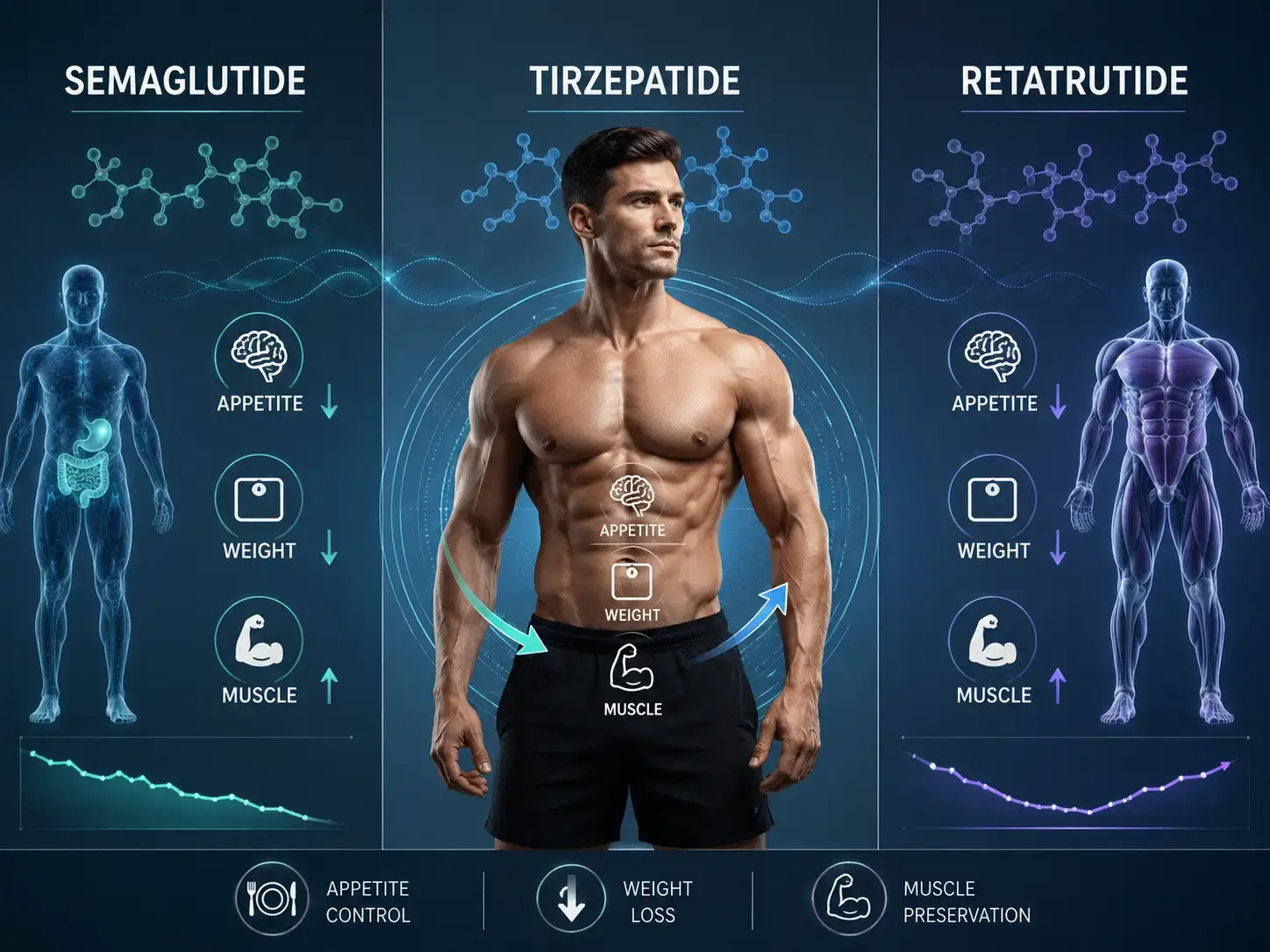
The range of medications available for weight management has expanded considerably. With more options, however, come more questions. How do modern weight-loss medications differ? How strongly do they affect appetite? And what happens to muscle tissue as body fat decreases?
Semaglutide, Tirzepatide, and Retatrutide act on hormonal pathways involved in satiety, eating behavior, and energy metabolism. For that reason, treatment outcomes should not be judged by the number on the scale alone. In this article, we compare the three compounds in practical terms, with a particular focus on appetite control, changes in body weight, and their effects on lean mass and skeletal muscle.
Their current status also differs significantly. Semaglutide and Tirzepatide are already used in clinical practice for appropriate indications, while Retatrutide remains an investigational compound.
Semaglutide, Tirzepatide, and Retatrutide: mechanisms of action and key differences
Semaglutide is a GLP-1 receptor agonist. It mimics the action of a naturally occurring incretin hormone involved in regulating satiety and blood glucose. In practice, this can reduce appetite, increase feelings of fullness, and lower overall food intake. When prescribed for weight management, Semaglutide is used according to a treatment plan established by a physician.
Tirzepatide differs through its dual mechanism of action, activating both GIP and GLP-1 receptors. In the head-to-head SURMOUNT-5 trial involving adults with obesity without diabetes, Tirzepatide produced greater average weight loss than Semaglutide – 20.2% versus 13.7% at 72 weeks.
Retatrutide is an investigational triple agonist targeting GIP, GLP-1, and glucagon receptors. This three-receptor mechanism is considered one of the reasons for the substantial weight-loss effects observed in clinical research. However, Retatrutide has not yet been approved as a standard obesity treatment, and its efficacy and safety profile continue to be evaluated.
How do these medications affect appetite and eating behavior?
All three compounds influence pathways involved in satiety and energy balance. Their effects therefore cannot be reduced simply to how strongly they suppress hunger.
Semaglutide can decrease appetite, increase satiety, and slow gastric emptying. This may make portion control easier and help people maintain a reduced-calorie diet.
Tirzepatide also has a pronounced effect on appetite and eating behavior, while additionally activating GIP receptors. Reduced hunger and stronger satiety can lower total food intake and make it easier to maintain a calorie deficit.
Retatrutide acts on three hormonal targets at the same time. Its triple mechanism has been associated with substantial effects on body weight and energy metabolism, although clinical experience in humans remains much more limited than with Semaglutide and Tirzepatide.
Appetite-control medications should therefore not be judged only by the question of “which suppresses hunger the most.” Satiety, tolerability, actual food intake, adverse effects, and the ability to maintain an appropriate diet over time are equally important.
Comparing Semaglutide, Tirzepatide, and Retatrutide for weight loss
In the STEP 1 trial, Semaglutide at 2.4 mg once weekly produced an average body-weight reduction of 14.9% over 68 weeks, compared with 2.4% in the placebo group.
Tirzepatide produced a greater effect in a direct comparison with Semaglutide. In SURMOUNT-5, average weight loss reached 20.2% with Tirzepatide versus 13.7% with Semaglutide at 72 weeks.
Retatrutide has shown very high levels of weight reduction within its own clinical development program. However, percentages from separate studies should be compared cautiously. Trials differ in duration, participant characteristics, doses, and methods used to assess outcomes.
It is therefore accurate to say that Tirzepatide outperformed Semaglutide in a direct head-to-head study. Retatrutide, however, cannot yet be placed confidently above either drug in a single effectiveness ranking because no direct comparative trial with Semaglutide or Tirzepatide has been completed.
Semaglutide: appetite control, weight loss, and effects on body composition
Semaglutide can reduce appetite considerably. For some people, this can make it more difficult to maintain their usual intake of food, protein, and total energy.
With substantial weight loss, not only fat mass but also part of the body’s lean mass may decrease. It is important to understand that lean mass is not the same as muscle mass. It includes water, internal organs, connective tissue, and other non-fat components of the body.
A reduction in lean mass therefore should not automatically be interpreted as an equivalent loss of skeletal muscle. For athletes, however, protein intake, resistance training, and maintenance of training performance remain particularly important.
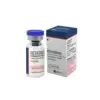
DEUS MEDICAL
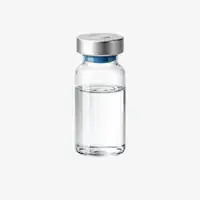
Semaglutide Peptide in Vials
Tirzepatide: mechanism and differences from Semaglutide
Tirzepatide acts on both GIP and GLP-1 receptors. This dual incretin activity is the main pharmacological feature that distinguishes it from Semaglutide.
In a direct comparison, Tirzepatide produced greater average weight loss. Body-composition data also show that weight reduction includes both fat mass and lean mass.
In a DXA analysis from SURMOUNT-1, approximately 75% of the weight lost came from fat mass and about 25% from lean mass.
This shows that most of the weight reduction came from fat, although some loss of lean tissue also occurred. Tirzepatide should therefore not be viewed as a medication that automatically protects muscle mass.
Retatrutide: potential of the new compound and current evidence
Retatrutide activates three receptors simultaneously – GIP, GLP-1, and glucagon. In an earlier clinical trial, the highest dose studied produced body-weight reduction of up to 24.2% over 48 weeks.
In 2026, Eli Lilly also reported positive results from several Phase III studies. In TRIUMPH-1, average weight loss with the 12 mg dose reached 28.3% at 80 weeks, while TRIUMPH-2 and TRIUMPH-3 reported reductions of up to 20.8% and 22.6%, respectively.
The status of these data is important. At the time this article was prepared, the Phase III findings had been announced by the manufacturer as preliminary topline results. A full assessment of efficacy, tolerability, and individual secondary outcomes therefore requires publication of the detailed trial data.
Among the individual studies discussed here, Retatrutide has produced the highest average levels of weight loss. However, there is still no direct head-to-head comparison with Semaglutide or Tirzepatide.
How does weight loss affect muscle mass?
Rapid weight loss can be accompanied by a reduction in lean tissue. This does not mean that the same percentage is lost directly from skeletal muscle, but preserving muscle mass becomes particularly important when the energy deficit is large and prolonged.
The most important factors include:
- adequate protein intake;
- regular resistance training;
- a moderate rate of weight loss;
- sufficient recovery;
- maintenance of training performance.
Overly aggressive food restriction increases the likelihood of unwanted losses in lean and muscle tissue regardless of which medication is being used.
Comparing the medications in terms of muscle preservation
Assessing the effects of these medications on muscle tissue is more complicated than tracking total body-weight change. For Semaglutide and Tirzepatide, DXA data and other body-composition assessments are already available. For Retatrutide, comparable information remains more limited.
Semaglutide reduces both fat mass and lean mass. The reduction in lean mass is not a unique adverse effect of the drug itself – it also occurs with many other forms of substantial weight loss.
Tirzepatide can also reduce lean mass, although body-composition analyses indicate that the majority of the weight loss comes from fat tissue.
With Retatrutide, the question is particularly important because the total degree of weight loss can be very pronounced. At present, however, there is not enough evidence to state confidently that Retatrutide is either better or worse than Semaglutide or Tirzepatide specifically for preserving skeletal muscle mass.
For athletes using any of these medications, the quality of weight loss matters as much as the speed. Maintaining strength, consuming sufficient nutrients, and monitoring body composition are therefore key considerations.
Tolerability and side effects: what should be considered?
For Semaglutide and Tirzepatide, gastrointestinal adverse effects remain among the most commonly reported. These include nausea, diarrhea, vomiting, constipation, and abdominal discomfort.
The severity of these symptoms varies between individuals and may also change depending on the stage of treatment and during dose escalation.
For Retatrutide, the safety profile continues to be assessed as part of its clinical development program. At present, it cannot be considered as extensively studied in routine medical practice as Semaglutide and Tirzepatide.
Tolerability is especially important for athletes because pronounced appetite suppression or persistent gastrointestinal symptoms may make it difficult to consume enough protein, fluids, and total energy to support muscle preservation.
How to choose a medication based on goals, risks, and health status
The choice of a weight-loss medication should not be based only on the highest percentage of weight reduction reported in a clinical trial. Each person has different goals, health considerations, and individual risk factors.
Before prescribing treatment, a physician considers factors such as existing medical conditions, current medications, potential contraindications, and individual tolerability.
The primary goal of treatment also matters. For one person, reducing overall body weight may be the main priority. For another, better appetite control and reducing persistent food cravings may be more important. For athletes, preserving muscle mass and training performance becomes an additional objective.
Semaglutide can be viewed as a well-studied GLP-1 receptor agonist with established effects on appetite and body weight.
Tirzepatide produced greater weight reduction than Semaglutide in a direct comparative trial and differs through its dual GIP/GLP-1 mechanism.
Retatrutide has shown very high efficacy in its Phase III clinical program, but it remains investigational and does not yet have the same regulatory status.
The final choice should therefore take into account not only potential effectiveness, but also health status, tolerability, treatment goals, and the importance of preserving muscle mass. The medication itself and the treatment regimen should be selected by a physician.
Semaglutide, Tirzepatide, or Retatrutide: key conclusions from the comparison
None of the three medications guarantees complete preservation of muscle tissue during weight loss. Nutrition, resistance training, and the rate of weight reduction remain major factors determining how body composition changes.
Semaglutide is a well-studied GLP-1 receptor agonist with established effectiveness for weight management.
Tirzepatide is a dual GIP/GLP-1 agonist that produced greater average weight loss than Semaglutide in a direct comparison.
Retatrutide is an investigational triple GIP/GLP-1/glucagon agonist that has shown very high levels of weight reduction in its clinical development program. However, it has not yet been directly compared with the other two medications and does not currently have the same regulatory status.
The comparison therefore cannot be reduced to the simple question of “which medication is stronger?” High-quality weight loss depends not only on the number of kilograms lost, but also on treatment tolerability, preservation of muscle function, nutrition, and overall health.