Deutsch
 English
 Français
 Español
 Italiano
 Svenska
 Čeština
 Nederlands
 Русский
 Українська
 Polski



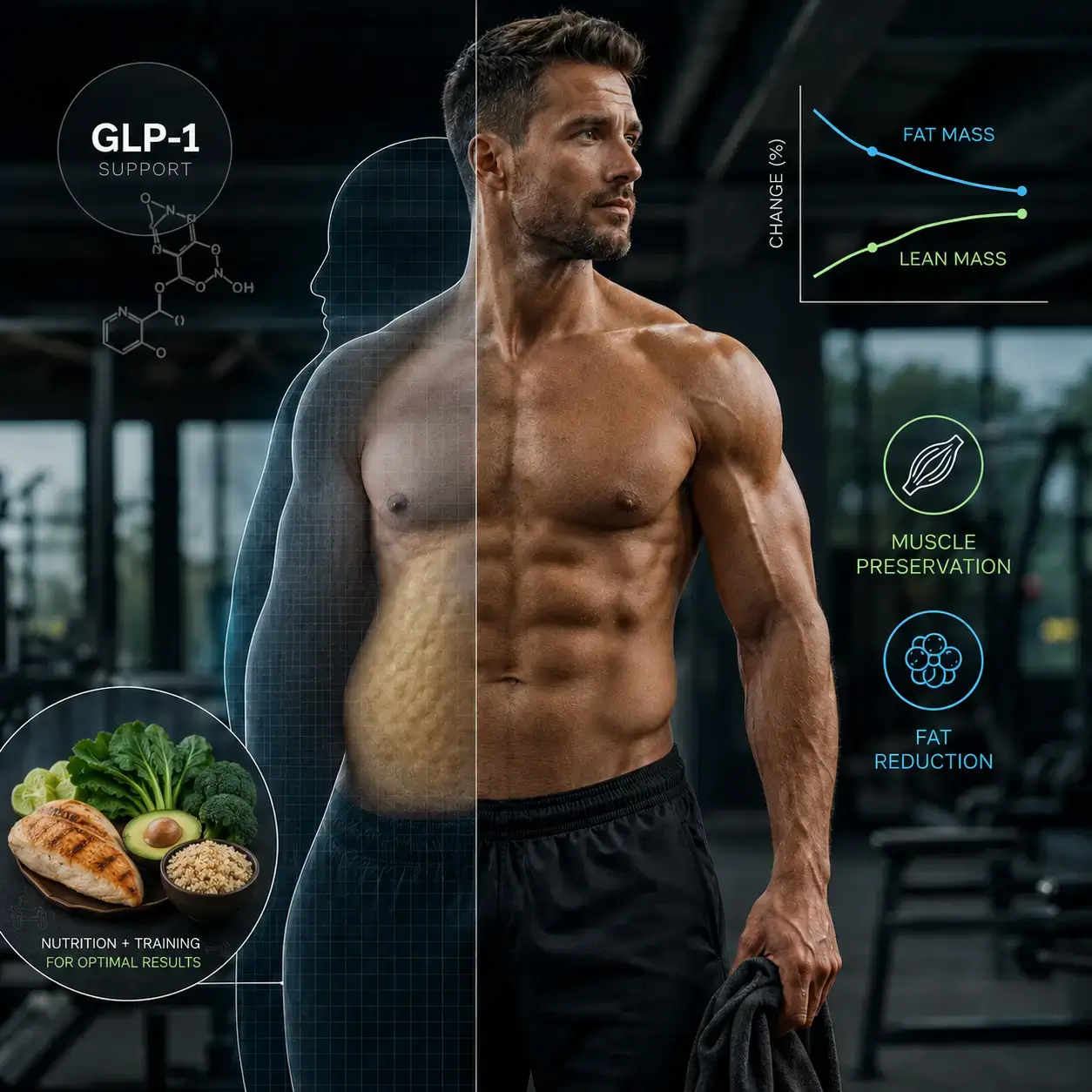
Medications that act on the incretin system, including GLP-1 receptor agonists, have become widely used in obesity treatment and weight management. As their popularity has grown, interest has also increased within fitness and strength sports, where preserving muscle mass during weight loss is especially important.
Rapid weight loss can create hidden problems for training performance, recovery, and muscle size. For athletes, the main objective is therefore to reduce body fat while limiting the loss of muscle tissue and functional performance as much as possible.
What are GLP-1 medications and how do they support weight loss?
Medications in this class mimic the action of the natural gut hormone GLP-1 or target several incretin receptors at the same time. A GLP-1 receptor agonist affects appetite-regulating centers in the central nervous system, increases feelings of fullness, and may slow gastric emptying.
As a result, many people find it easier to control food intake and maintain a lower-calorie diet.
GLP-1 medications also affect carbohydrate metabolism. They enhance glucose-dependent insulin secretion, regulate glucagon release, and help improve blood glucose control.
Reduced appetite can make it easier to create a calorie deficit, but treatment tolerance varies considerably between individuals. In some people, a pronounced decrease in appetite or gastrointestinal side effects such as nausea may make it harder to consume enough protein, calories, and other essential nutrients.
It is also important to remember that Semaglutide, Tirzepatide, and other medications in this category were not developed as bodybuilding or contest-prep drugs. Their medical use is primarily associated with the treatment of obesity, excess body weight, and disorders of glucose metabolism when clinically indicated.
Why can muscle mass decrease during weight loss?
During a prolonged calorie deficit, the body receives less energy than it expends. Most of the required energy comes from stored body fat, but when weight loss is very rapid or the deficit becomes too aggressive, lean mass can also decrease.
The risk is particularly high when several factors occur together:
- an excessively large energy deficit;
- insufficient protein intake;
- lack of regular resistance training;
- rapid weight loss;
- inadequate recovery.
During a pronounced energy deficit, amino acids may contribute more to energy metabolism, while the conditions for preserving muscle tissue become less favorable.
In clinical trials of weight-loss medications, part of the lost body weight does indeed come from lean mass. However, it is important to distinguish between lean mass and skeletal muscle. Lean mass also includes water, organs, connective tissue, and other non-fat components of the body.
For this reason, saying that a certain percentage of weight loss consists directly of “burned muscle” is an oversimplification.
For a bodybuilder, the number on the scale should not be the only reference point. Strength levels, muscle size, and training performance are equally important indicators.
How do GLP-1 agonists affect fat, muscle, and body composition?
GLP-1 primarily affects appetite regulation, satiety, and glucose metabolism. During treatment, many people find it easier to maintain a calorie deficit, which creates the conditions for weight loss.
However, the medication itself does not determine exactly which tissue will be lost. Most weight reduction usually comes from fat mass, but some reduction in lean mass can also occur.
GLP-1 medications should therefore not be viewed as compounds that automatically preserve muscle tissue.
For athletes, it is useful to monitor several factors at the same time:
- body-weight trends;
- working weights in the gym;
- training performance;
- body measurements;
- overall well-being and recovery.
If weight loss is accompanied by a pronounced and persistent decline in strength, poorer recovery, or an inability to consume enough nutrients, the situation should be discussed with the prescribing physician and, where appropriate, a nutrition professional.
The goal is controlled weight loss in which the greatest possible proportion of the reduction comes from fat mass while muscle tissue and functional capacity are preserved as much as possible.
Semaglutide and Tirzepatide: differences in weight loss and muscle preservation
Semaglutide and Tirzepatide belong to different incretin-based drug classes and have both demonstrated substantial weight reduction in clinical studies.
Semaglutide is a GLP-1 receptor agonist. Its effects are associated with regulation of appetite, satiety, gastrointestinal motility, and glucose metabolism.

DEUS MEDICAL
Semaglutide Peptide in Vials
Tirzepatide activates both GIP and GLP-1 receptors. This dual incretin activity has been associated with greater average weight loss in clinical trials, but the effect should not be reduced to a simple increase in lipolysis or direct “fat burning.”
Both medications can markedly suppress appetite. The intensity of this effect, as well as the likelihood of nausea and other gastrointestinal side effects, varies from person to person.
It is therefore not accurate to assume in advance that Semaglutide is always “milder” or that Tirzepatide necessarily carries a greater risk of insufficient protein intake or muscle loss.
With either medication, athletes should pay particular attention to total calorie and protein intake if appetite suppression becomes strong enough to make their usual diet difficult to maintain.
Neither Semaglutide nor Tirzepatide replaces resistance training or a well-structured diet. The choice of medication, the indication for treatment, and any changes to therapy should be determined by a physician based on the patient’s individual health status.
How to preserve muscle mass while using GLP-1 medications
Preserving muscle tissue during medically assisted weight loss requires a systematic approach. The faster body weight decreases and the lower energy availability becomes, the more important adequate protein intake and regular resistance training are.
The main practical principles include:
- consume enough high-quality protein — for most people who train regularly, around 1.6–2.2 g per kilogram of body weight per day can serve as a general reference, with individual adjustment when body fat is very high or calorie intake is especially low;
- maintain regular resistance training;
- avoid an excessively large and prolonged calorie deficit;
- monitor recovery and sleep quality;
- maintain adequate intake of vitamins, minerals, and other essential nutrients;
- consider creatine, where appropriate, as an additional tool for supporting strength and high-intensity performance.
Separate BCAA supplementation is not essential for preserving muscle if the diet already provides sufficient high-quality protein and essential amino acids.
These measures cannot guarantee that no lean mass will be lost at all, but they can help reduce the risk of excessive muscle loss.
If appetite becomes so suppressed that it is difficult to consistently consume enough food and protein, the prescribing physician should be consulted to assess tolerance and whether treatment needs to be adjusted.
Muscle preservation becomes particularly important during longer periods of weight loss. The longer the calorie deficit continues, the more carefully strength levels, recovery, and overall energy availability should be monitored.
Nutrition, protein, and calorie deficit during weight loss
A well-planned calorie deficit should remain moderate. Reducing energy intake too aggressively increases the likelihood of declining training performance and greater loss of lean mass.
Protein is best distributed across several meals throughout the day. This provides a regular supply of essential amino acids and can be especially practical when appetite is reduced.
When overall food volume falls substantially, attention should not be limited to protein alone. Nutritional quality also matters, as a calorie deficit may reduce the intake of vitamins, minerals, fiber, and essential fatty acids.
If consuming enough solid food becomes difficult during GLP-1 therapy, nutrient-dense foods and protein shakes can be practical options. They make it easier to obtain more protein without requiring a large volume of food.
A moderate calorie deficit, adequate protein intake, and regular resistance training can help increase the proportion of weight loss that comes from body fat while limiting the reduction in lean mass as much as possible.
Even with a well-structured program, however, it is impossible to guarantee that every kilogram lost will come exclusively from fat.
Strength training and progress monitoring during weight loss
Using GLP-1 medications does not remove the need for regular resistance training. Training against resistance provides the mechanical stimulus needed to help maintain muscle tissue during an energy deficit.
Cardio can also be useful for increasing energy expenditure and supporting cardiovascular fitness. However, combining a very high cardio volume with an aggressive calorie deficit, insufficient protein intake, and no resistance training increases the risk of losing muscle mass.
For many athletes, 2–4 resistance-training sessions per week can be a practical range. The optimal frequency depends on training experience, total workload, the size of the deficit, and the quality of recovery.
The main conditions for effective training include:
- maintaining regular resistance training;
- using sufficient training intensity;
- controlling total training volume;
- gradually adjusting training load when recovery deteriorates;
- allowing adequate rest between demanding sessions.
The number on the scale alone does not show which type of tissue is being lost.
For a more precise assessment of body composition, **DEXA scanning** can be used. Bioelectrical impedance is more accessible and can be useful for tracking overall trends, but the results are more strongly affected by hydration, food intake, and testing conditions.
Body measurements, progress photos taken under similar conditions, and trends in working weights can also be useful. Taken together, these indicators provide a much clearer picture of the quality of the weight loss.
GLP-1 medications and muscle preservation: key takeaways
The use of GLP-1 medications for weight reduction should be considered carefully and should follow appropriate medical indications. These medications can help control appetite and make a reduced-calorie diet easier to maintain, but the resulting changes in body composition still depend heavily on nutrition, training, and the rate of weight loss.
The main objective is to ensure that the greatest possible proportion of weight loss comes from body fat while preserving muscle mass and its functional capacity as much as possible.
This requires a systematic approach: a moderate calorie deficit, sufficient protein intake, regular resistance training, adequate sleep, and close attention to recovery.
Semaglutide and Tirzepatide have different pharmacological characteristics, so choosing between them simply on the basis of “which one is stronger” is not a useful approach. Both can significantly affect appetite, body weight, and eating behavior, while individual tolerance can vary substantially.
When medically indicated, the specific GLP-1 medication should be selected by a physician based on health status, treatment indication, potential risks, and the individual response to therapy. For athletes, the additional objective is to preserve strength performance and muscle tissue throughout the entire period of weight loss.