Deutsch
 English
 Français
 Español
 Italiano
 Svenska
 Čeština
 Nederlands
 Русский
 Українська
 Polski



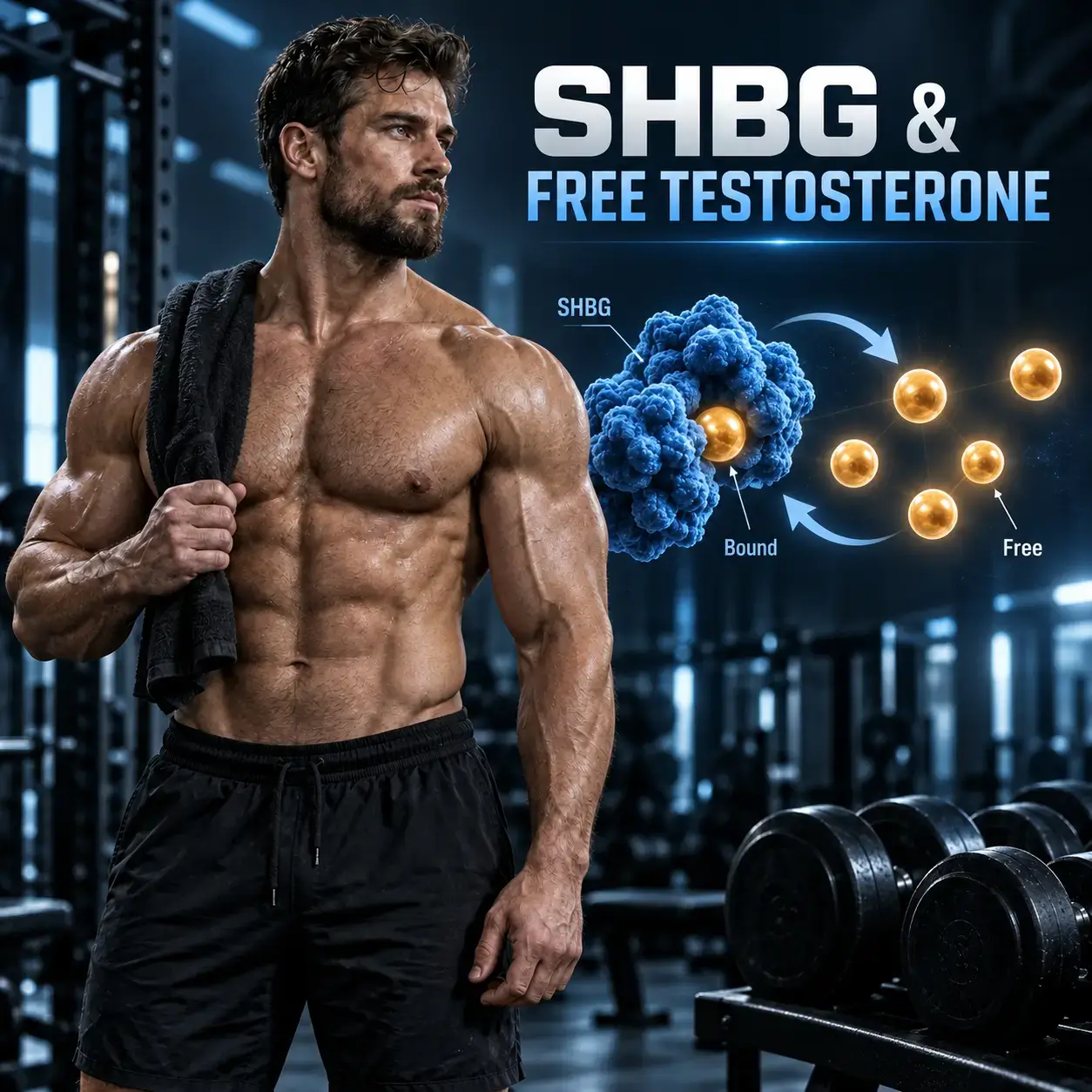
Sex hormone-binding globulin (SHBG) is frequently discussed in bodybuilding, particularly in connection with testosterone use and anabolic steroids. Some athletes see high SHBG as an obstacle to building muscle. Others try to lower it, hoping to increase the amount of free testosterone in their bloodstream.
The reasoning seems straightforward: the less testosterone is bound to a protein, the more of it may remain in its free form. In the body, however, this relationship is not quite so simple. SHBG concentrations are influenced not only by testosterone levels but also by liver function, metabolic health, and the activity of other hormones.
Let’s look at how SHBG affects androgen status, why its concentration can change during a steroid cycle, and what bodybuilders should actually consider when interpreting their blood test results.
What is SHBG, and what role does it play in the body?
SHBG stands for Sex Hormone-Binding Globulin. It is a protein produced primarily by the liver that binds to sex hormones, particularly testosterone and estradiol, and helps transport them through the bloodstream.
This binding affects how hormones are distributed and how readily they are available to tissues. SHBG concentration is therefore relevant when assessing hormonal status, although the value alone does not indicate how strongly testosterone is acting on muscle tissue.
Several factors can influence SHBG levels:
- thyroid hormones;
- liver function and liver health;
- body weight and body composition;
- insulin resistance and carbohydrate metabolism;
- sex hormone levels and exposure to androgenic compounds.
For example, SHBG concentrations are often lower in people with obesity or insulin resistance. Changes in thyroid function can also cause the value to move considerably outside its usual range.
Normal SHBG levels differ between men and women. Reference ranges also vary with age, the laboratory, and the testing method used. For this reason, it is generally more useful to refer to the range provided on the specific laboratory report.
For an athlete, the goal should not be to reach a particular position within the reference range. Understanding the reason for an abnormal result and how it relates to other hormonal markers is far more important.
SHBG and testosterone: effects on free and bound hormone fractions
Testosterone circulates in the blood in three main forms:
- free testosterone, which is not bound to proteins;
- testosterone tightly bound to SHBG;
- testosterone relatively loosely bound to albumin.
Free testosterone accounts for only a small proportion of total testosterone. Because the bond with albumin is considerably weaker, free and albumin-bound testosterone are often considered together as the bioavailable fraction.
When SHBG is high, total testosterone may remain within the normal range or even be elevated, while the free fraction is relatively low.
The opposite situation is also possible. With low SHBG, the proportion of free hormone may increase, but that does not necessarily mean its absolute concentration is high. In people with metabolic disorders, for example, reduced SHBG is often accompanied by lower total testosterone.
What does this look like in practice?
Imagine two athletes with identical total testosterone results. The first has SHBG around the middle of the laboratory reference range, while the second has significantly elevated SHBG. Despite having the same total testosterone, their calculated free testosterone levels may differ.
This is why assessing a suspected hormonal disorder may require looking at SHBG alongside total testosterone.
How to assess free testosterone correctly
Hormonal assessment usually begins with a total testosterone test. If the result is close to the lower limit of the reference range or SHBG is substantially altered, a physician may also assess the free fraction.
Free testosterone can be measured using equilibrium dialysis or calculated from total testosterone, SHBG, and albumin. Conventional direct free testosterone immunoassays may not be sufficiently accurate.
When male hypogonadism is suspected, symptoms must also be considered, and a low testosterone result should be confirmed with a repeat morning blood test.
For bodybuilders, free testosterone is useful as one indicator of androgen status. However, a laboratory result cannot be used to calculate how much muscle an athlete will gain or how much their strength will improve.
How does SHBG affect muscle growth and training results?
The relationship between SHBG and muscle growth cannot be reduced to the idea that “the lower, the better.”
Testosterone plays a role in regulating muscle protein metabolism, but the anabolic response depends on much more than the concentration of a hormone in the bloodstream. Training load, nutrition, recovery, individual tissue sensitivity to androgens, and overall endocrine health all matter.
Low SHBG does not guarantee faster muscle growth. An athlete with a low value will not necessarily progress better than someone whose SHBG sits near the middle of the reference range.
Likewise, high SHBG does not mean that an anabolic response is impossible. What matters is whether it is accompanied by reduced free testosterone and whether there are signs of a hormonal disorder.
Regular exercise and changes in body composition can also affect SHBG. For example, losing excess body fat may increase its concentration while metabolic markers improve at the same time.
For assessing athletic progress, it is therefore more useful to consider hormone tests alongside actual results: changes in strength, body composition, recovery, and general well-being.
SHBG levels in athletes: changes during a testosterone cycle
SHBG concentrations may decrease during the use of exogenous testosterone. The extent of this change depends on androgen exposure, individual response, and any other compounds being used.
An important point is that hormone test results during a steroid cycle can differ substantially from those of someone who is not using anabolic-androgenic steroids (AAS).
For example, total testosterone may be significantly elevated because of the exogenous hormone being introduced. At the same time, natural testosterone production is suppressed, while SHBG concentration changes under the influence of androgens.
In this situation, low SHBG often reflects the pharmacological exposure. By itself, it does not indicate how well an athlete is recovering, how quickly their muscles are growing, or whether androgenic activity in their tissues is sufficient.
Calculated free testosterone requires particularly careful interpretation. At very high total testosterone concentrations, especially when binding protein levels are substantially altered, some calculation methods may become less accurate. Standard laboratory reference ranges are also not designed to assess the effectiveness of non-medical use of high-dose androgens.
After AAS are discontinued, the hormonal picture changes again. At that stage, SHBG and total testosterone are not the only relevant parameters. Recovery of the body’s own hormonal axis also needs to be considered.
Directly comparing a blood test taken during a cycle with one obtained after discontinuation, without accounting for these circumstances, can therefore be misleading.
How anabolic steroids affect SHBG levels
Anabolic-androgenic steroids can alter SHBG synthesis in the liver. However, the magnitude of this effect varies between compounds.
A marked reduction in SHBG has been described with Stanozolol, for example. This effect has been investigated in studies of androgen sensitivity and demonstrates how the compound can influence production of the binding protein.
However, Stanozolol does not act exclusively on SHBG. Its use is also associated with changes in the lipid profile, potential effects on the liver, and suppression of natural hormonal function.
Other AAS may have different effects on SHBG. In addition, anabolic steroids vary in their affinity for the binding protein.
This distinction matters when interpreting blood tests. Neither SHBG concentration nor calculated free testosterone can directly determine the combined androgenic activity of all the compounds present in the body.
When multiple AAS are used, hormone results therefore need to be interpreted in the context of the specific compounds involved and their pharmacological properties, rather than focusing solely on changes in a single binding protein.
Lowering SHBG during a steroid cycle: when is it actually necessary?
An elevated SHBG result often makes athletes want to lower it immediately. But before considering medication to change the value, it is important to establish why it has changed in the first place.
A useful starting point is to consider several parameters together: total testosterone, SHBG, free testosterone when appropriate, any relevant symptoms, and the circumstances surrounding the blood test.
Different situations can arise in practice.
| Situation | What to consider |
| High SHBG with normal total testosterone | If symptoms are present, further assessment of free testosterone may be appropriate. |
| High SHBG and low free testosterone | It is important to identify the cause of the changes and assess the overall hormonal profile. |
| Low SHBG in someone who is overweight | Metabolic health and possible insulin resistance deserve attention. |
| SHBG decreases during an AAS cycle | The change may reflect the action of the compounds rather than a separate hormonal disorder. |
| Elevated SHBG without symptoms or other abnormalities | An isolated laboratory result does not necessarily require medication to correct it. |
If SHBG is elevated, possible causes to consider include changes in thyroid function, liver disease, nutritional factors, and the effects of certain medications.
When SHBG is low, body weight, carbohydrate metabolism, liver function, and overall hormonal status should be taken into account.
But what if SHBG changes specifically during a steroid cycle?
The first consideration is the nature of the pharmacological exposure. A decrease in SHBG may be an expected response to exogenous androgens. If the value is elevated, possible causes should be assessed rather than automatically attempting to counteract it with another compound.
Correcting a single laboratory value without understanding the broader hormonal picture may not produce the expected result.
Compounds that lower SHBG and the risks of excessive suppression
Some compounds used in sports pharmacology can reduce SHBG concentration. However, lowering the binding protein is only one aspect of their pharmacological activity and is not, by itself, a reason to use them.
In bodybuilding, interest in these compounds is generally driven by the desire to increase the free testosterone fraction. It is important, however, to distinguish between a change in a laboratory marker and an actual anabolic benefit.
If a compound simultaneously suppresses natural hormone production, affects the liver, and worsens the lipid profile, its effect on SHBG cannot be considered separately from those consequences.
SHBG also plays a role in the normal distribution of sex hormones. There is no demonstrated muscle-building advantage to deliberately pushing its concentration as low as possible.
If an abnormal SHBG result is caused by a metabolic or endocrine disorder, addressing that underlying condition should be the priority.
Medication intended to correct hormonal status should therefore be used for medical indications, not simply to achieve a particular SHBG number on a blood test.
SHBG in bodybuilding: key takeaways
SHBG influences how testosterone is distributed between its bound and free fractions. Its concentration is therefore relevant when assessing hormonal status, particularly when total testosterone does not match an individual’s symptoms or other examination results.
For athletes using exogenous testosterone or other AAS, interpretation becomes more complicated. Androgenic compounds can lower SHBG, suppress natural hormonal function, and alter other laboratory markers.
There is no universal “ideal SHBG level for bodybuilding,” however. SHBG concentration cannot directly predict muscle gain, the effectiveness of a cutting phase, or the rate of recovery after training.
When a result falls outside the reference range, it is important to investigate the cause and assess it alongside total and free testosterone, relevant symptoms, and overall health.
For athletes, the practical principle remains the same: blood tests help explain what is happening within the hormonal system, but actual training results depend on a much wider range of factors.