Deutsch
 English
 Français
 Español
 Italiano
 Svenska
 Čeština
 Nederlands
 Русский
 Українська
 Polski



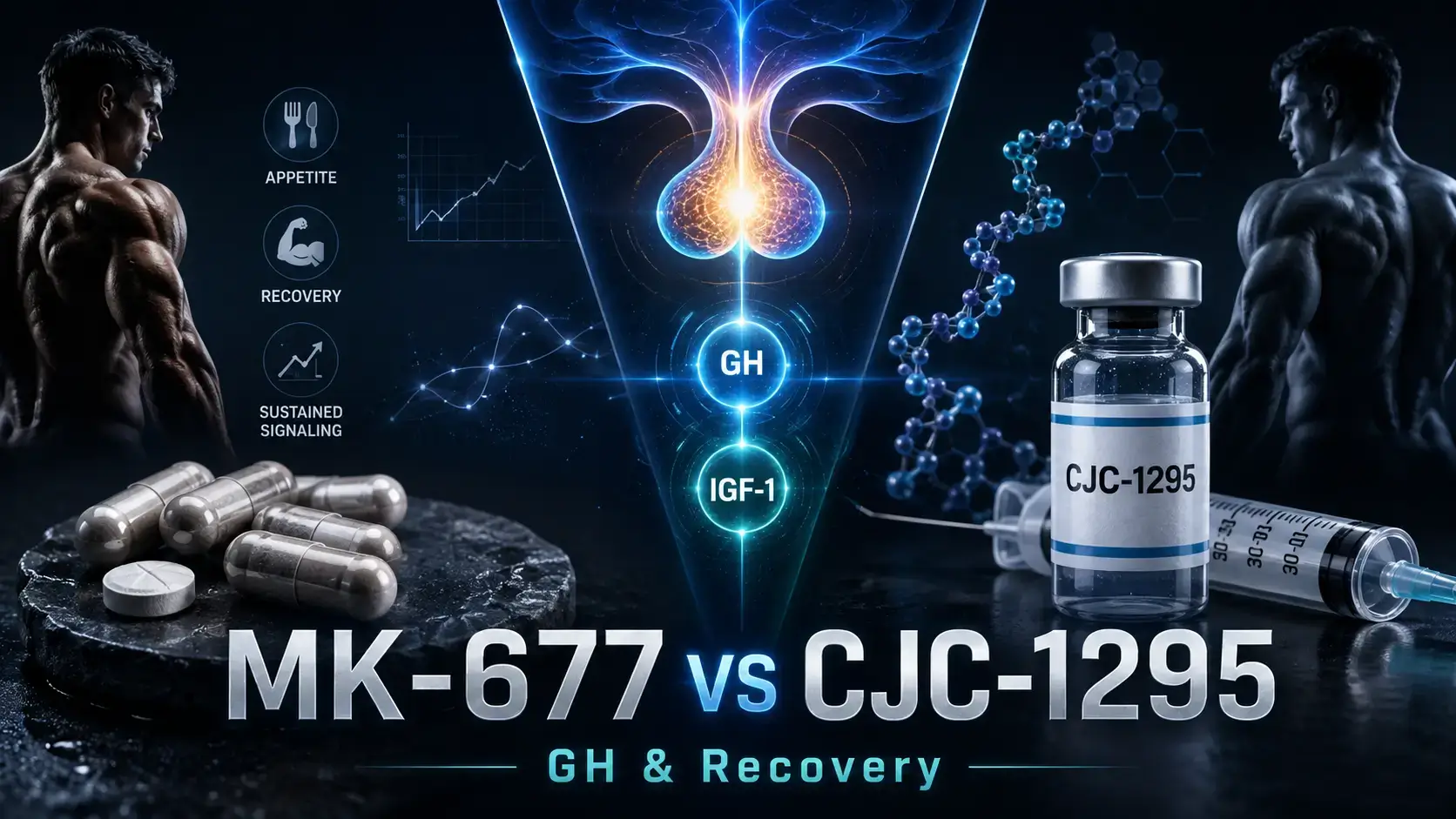
Stimulating endogenous growth hormone secretion remains a widely discussed area of sports pharmacology. In bodybuilding and strength sports, two compounds frequently mentioned in this context are MK-677 (ibutamoren) and CJC-1295. Both influence the GH/IGF-1 axis, but they act through different receptor systems and differ substantially in their pharmacological properties, pharmacokinetics, route of administration and potential side-effect profiles.
MK-677 is a non-peptide ghrelin receptor agonist that is taken orally. CJC-1295, by contrast, is a synthetic analogue of growth hormone-releasing hormone (GHRH), which stimulates the pituitary gland to release growth hormone, and is administered by injection.
For this reason, comparing MK-677 with CJC-1295 should not be reduced to the question of which compound raises growth hormone more strongly. Duration of action, effects on appetite and glucose metabolism, route of administration, changes in IGF-1 and the limited evidence for performance-related outcomes in trained athletes are equally important.
MK-677 and CJC-1295: Key Characteristics of Growth Hormone Secretagogues
The main difference between the two compounds lies in how they influence the somatotropic system.
MK-677 is not a peptide. It is an orally active agonist of the growth hormone secretagogue receptor GHS-R1a, which is also the ghrelin receptor. By activating this receptor, MK-677 can increase endogenous GH secretion and raise circulating IGF-1 levels.
One important consequence of this mechanism is its effect on appetite. Because the ghrelin system plays a role in the regulation of hunger and food intake, MK-677 can noticeably increase appetite in some users. During a calorie-surplus phase, this may have practical relevance. During a cutting phase, however, the same effect can make adherence to a calorie-restricted diet more difficult.
CJC-1295 is a synthetic GHRH analogue. It is not growth hormone itself. Instead, it acts on GHRH receptors in the pituitary gland and stimulates the release of endogenous growth hormone.
It is important to distinguish between two forms that are often grouped together under the same name in bodybuilding:
- CJC-1295 with DAC – a long-acting version designed to provide prolonged exposure;
- CJC-1295 without DAC – a shorter-acting GHRH analogue more commonly associated with brief, pulsatile stimulation of GH secretion.
Statements such as “CJC-1295 is short-acting” or, conversely, “CJC-1295 lasts for several days” can therefore be misleading unless the specific form is clearly identified.
Both compounds can stimulate the GH/IGF-1 axis, but they do so through different pathways: MK-677 through the ghrelin receptor and CJC-1295 through the GHRH system.
How MK-677 Works: Effects on Growth Hormone Secretion and IGF-1
The mechanism of action of MK-677 is based on activation of the GHS-R1a receptor. Through this pathway, the body receives a signal that can enhance endogenous growth hormone secretion.
After GH levels rise, part of its metabolic and anabolic signalling is mediated through IGF-1, or insulin-like growth factor 1, which is produced largely in the liver.
Clinical studies of ibutamoren have demonstrated increases in both GH secretion and IGF-1 levels. Its action is fundamentally different from the direct administration of exogenous growth hormone: MK-677 stimulates the body’s own somatotropic system rather than supplying GH from an external source.
For athletes, one of the most notable characteristics is its relatively prolonged pharmacodynamic activity. With regular use, elevated IGF-1 levels may remain sustained over time, which is one reason MK-677 is often contrasted with shorter-acting peptide secretagogues.
However, a substantial increase in GH or IGF-1 does not automatically translate into a proportional increase in muscle mass, strength or recovery speed. Outcomes depend on factors such as age, baseline hormonal status, diet, training load and individual response.
The ghrelin activity of the compound also deserves particular attention. Increased hunger is not an unrelated side effect but a direct consequence of MK-677’s mechanism of action.
How CJC-1295 Works: Growth Hormone Stimulation and Peptide Pharmacology
The mechanism of CJC-1295 differs fundamentally from that of ibutamoren. The peptide interacts with GHRH receptors on somatotroph cells in the pituitary gland and enhances the release of endogenous growth hormone.
Its pharmacological profile depends significantly on the specific form.
CJC-1295 with DAC is able to remain in circulation for considerably longer because of its Drug Affinity Complex modification. This extends its duration of action and results in a more prolonged elevation of average GH and IGF-1 levels.
The version without DAC acts for a much shorter period. In bodybuilding, it is more commonly discussed in the context of brief, pulsatile stimulation of growth hormone because the concentration of the compound declines more rapidly.
This distinction is particularly relevant when comparing CJC-1295 with MK-677. Ibutamoren produces more sustained stimulation through the ghrelin system, while the short-acting form of CJC-1295 is conceptually closer to the physiological pattern of individual GH pulses.
This does not mean that either approach automatically creates a “more anabolic” hormonal profile. Clinical research on CJC-1295 primarily demonstrates its ability to increase GH and IGF-1, while high-quality evidence for increases in muscle mass or athletic performance in trained individuals remains much more limited.
MK-677 and CJC-1295: Effects on Recovery After Training
Recovery is one of the main reasons athletes are interested in the GH/IGF-1 system. These hormonal signals are involved in tissue metabolism, protein synthesis, connective-tissue remodelling and other processes associated with recovery.
With MK-677, additional interest comes from its potential effects on sleep. Small studies have reported changes in certain stages of sleep, which may theoretically be relevant for athletes exposed to high training loads.
Claims of “continuous 24/7 recovery” or guaranteed accelerated muscle recovery, however, are not supported by adequate evidence. Elevated IGF-1 does not eliminate the need for sufficient sleep, adequate calorie and protein intake or appropriate training periodisation.
CJC-1295 is also discussed in relation to recovery because it stimulates endogenous GH secretion. In theory, activation of the GH/IGF-1 axis may influence collagen turnover and connective-tissue metabolism.
It is important, however, to distinguish between a plausible physiological mechanism and a demonstrated clinical outcome. There is insufficient evidence to confidently state that CJC-1295 accelerates the healing of ligaments, cartilage or joint structures in athletes.
The potential relevance of both compounds to recovery therefore comes primarily from their effects on the somatotropic system. They should not be presented as proven treatments for sports injuries.
MK-677 and CJC-1295 for Muscle Growth: Differences in Practical Use
When muscle growth is the goal, MK-677 and CJC-1295 are also viewed differently in practice.
MK-677 can increase appetite, which may make it easier for some athletes to consume enough energy during a calorie-surplus phase. For people who struggle to maintain a consistently high calorie intake, this effect can be noticeable in practice.
Studies of ibutamoren have also reported increases in fat-free mass. It is important, however, to understand that fat-free mass is not synonymous with newly built skeletal muscle. The measurement also includes water, glycogen and other non-fat components of the body.
MK-677 may also cause fluid retention. Rapid increases in body weight should therefore not automatically be interpreted as muscle gain.
CJC-1295 does not directly activate the ghrelin receptor and therefore does not have the characteristic appetite-stimulating effect associated with MK-677. This is one of the clearest practical differences between the compounds.
Higher GH levels may potentially influence lipid metabolism and body composition, but there is insufficient evidence to regard CJC-1295 as a proven compound for producing “dry muscle gains” or substantial fat loss in athletes.
In both cases, actual changes in body composition depend primarily on:
- total calorie intake;
- protein intake;
- training stimulus;
- the quality and duration of recovery;
- baseline body-fat percentage;
- individual response.
An increase in GH and IGF-1 should therefore be clearly distinguished from guaranteed muscle hypertrophy.
MK-677 vs CJC-1295: Effectiveness, Safety, Advantages and Limitations
Clinical research confirms that both MK-677 and CJC-1295 can influence the GH/IGF-1 axis. However, the evidence supporting their specific use in bodybuilding is considerably weaker than is sometimes suggested within the fitness community.
The systemic effects of MK-677 have been studied more extensively during longer periods of administration. This has also helped identify several potential limitations.
The most relevant include:
- increased appetite;
- fluid retention and oedema;
- increased fasting glucose in some individuals;
- reduced insulin sensitivity;
- a possible increase in blood pressure associated with fluid retention;
- tingling or numbness in the extremities in some users.
Glucose metabolism deserves particular attention. An increase in GH and IGF-1 should therefore not be treated as an exclusively positive outcome without considering the potential metabolic consequences.
There are fewer human data available for CJC-1295. Early studies demonstrated its ability to produce sustained increases in GH and IGF-1 and suggested generally acceptable short-term tolerability. These findings are not sufficient, however, to establish long-term safety.
Potential adverse reactions associated with peptide secretagogues may include injection-site reactions, headache, flushing, changes in general well-being and possible consequences of chronically stimulating the GH/IGF-1 axis.
It also cannot be stated with confidence that CJC-1295 is completely neutral with respect to glucose metabolism. The effects of MK-677 on glucose levels and insulin sensitivity are simply better characterised, while substantially fewer long-term comparative data are available for CJC-1295.
The safety comparison between MK-677 and CJC-1295 therefore cannot be reduced to the assumption that “the peptide is safer.” The metabolic limitations of one compound are better documented, while the other carries greater uncertainty because of the smaller amount of long-term evidence.
Anti-doping status is another important consideration for competitive athletes. Compounds that stimulate growth hormone secretion are subject to anti-doping restrictions, so athletes should always refer to the current WADA Prohibited List when competing under anti-doping rules.
How MK-677 and CJC-1295 Differ Depending on an Athlete’s Goals
When comparing MK-677 with CJC-1295 in practice, it makes sense to look beyond their ability to increase GH and consider the characteristics of each mechanism.
MK-677 is more commonly considered in situations where the following characteristics are relevant:
- oral administration;
- prolonged stimulation of the GH/IGF-1 axis;
- increased appetite during a bulking phase;
- no need for injections.
At the same time, increased hunger, fluid retention and potential effects on glucose metabolism may become significant limitations.
CJC-1295 tends to attract attention because of:
- its action through the GHRH receptor;
- the absence of direct ghrelin-receptor stimulation;
- the absence of the characteristic appetite increase associated with MK-677;
- the distinction between short-acting and long-acting forms of the peptide.
With CJC-1295 DAC, prolonged action is the defining characteristic. The version without DAC produces substantially shorter stimulation.
The question “MK-677 or CJC-1295 – which is better?” therefore has no universal answer. The compounds act through different biological mechanisms, and their respective advantages and limitations depend on the specific goal and individual response.
In non-medical sports practice, compounds acting on different parts of the somatotropic system are sometimes used together. However, there is insufficient clinical evidence to show that combining MK-677 and CJC-1295 provides a clear advantage over either compound alone. More intensive stimulation of the GH/IGF-1 axis does not automatically produce a greater beneficial effect and can make it more difficult to identify the cause of adverse reactions.
MK-677 or CJC-1295: Key Differences and What Matters Most
MK-677 and CJC-1295 both stimulate the endogenous growth hormone axis, but their mechanisms of action are substantially different.
Ibutamoren is a non-peptide ghrelin receptor agonist. It is taken orally, can produce sustained increases in GH and IGF-1 and often increases appetite. At the same time, MK-677 has been associated with fluid retention and potentially unfavourable changes in glucose metabolism.
CJC-1295 is a GHRH analogue that acts directly on the physiological pathway responsible for pituitary growth hormone release. A clear distinction must be made between the long-acting DAC form and the substantially shorter-acting version without DAC.
Both compounds attract interest because of their potential effects on recovery, fat-free mass and body composition. However, increases in GH and IGF-1 do not guarantee rapid muscle growth, significant fat loss or faster healing of injuries.
The main difference therefore lies not in an abstract measure of which compound is “stronger,” but in how each stimulates the somatotropic system, how long the effect lasts, how the compound is administered and the type of adverse effects that may occur.
When comparing MK-677 vs CJC-1295, it is more useful to compare their mechanisms and limitations than to look for a universal winner. Training quality, nutrition, sleep and recovery remain the primary determinants of athletic progress, while the use of compounds that alter hormonal regulation requires particular attention to health.