Deutsch
 English
 Français
 Español
 Italiano
 Svenska
 Čeština
 Nederlands
 Русский
 Українська
 Polski



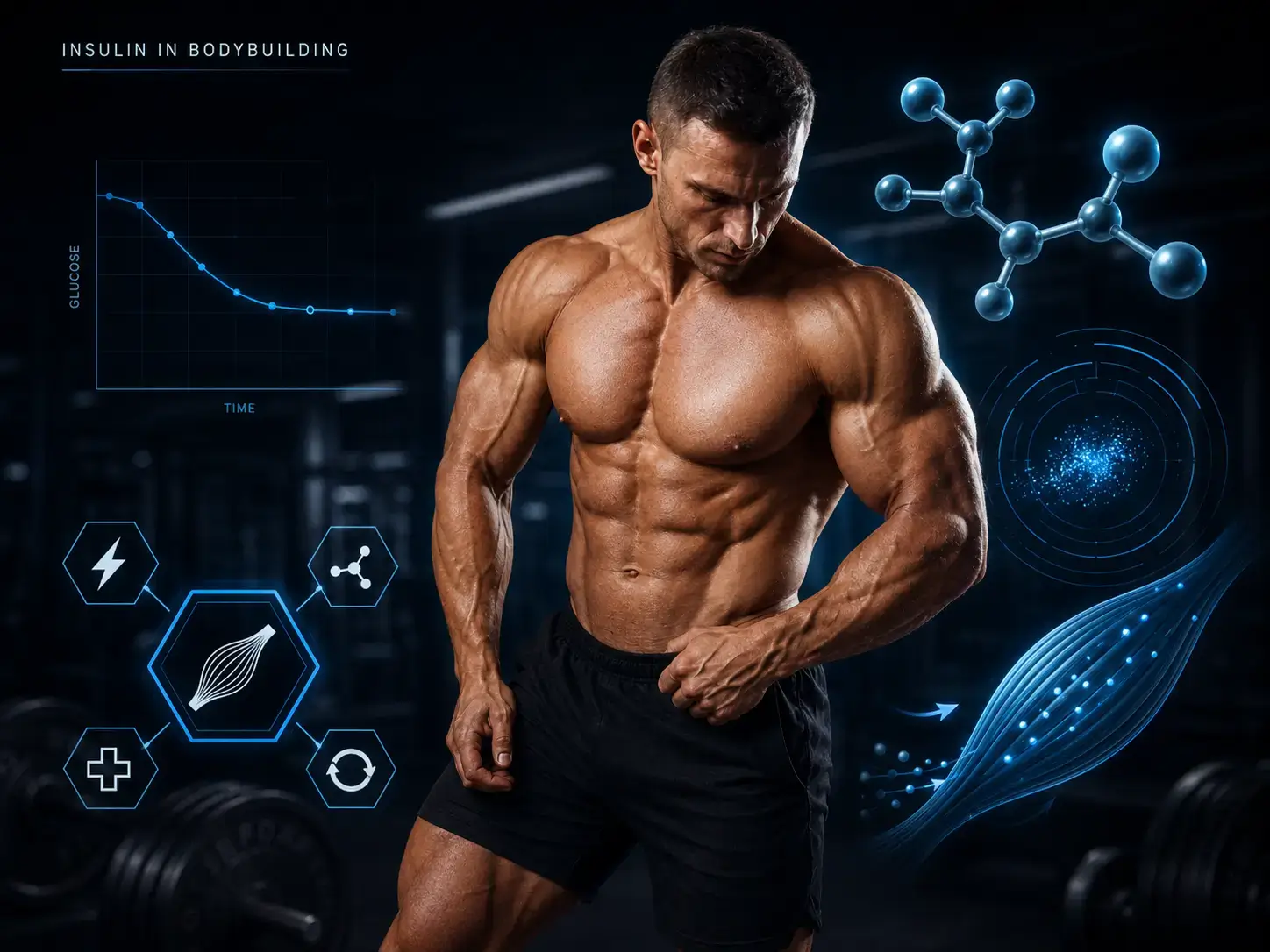
In professional sports and competitive fitness, athletes are constantly looking for ways to optimize physical performance and body composition. One of the most debated factors in this context is insulin. Many athletes are interested in how it works and how it may affect training quality, recovery and muscle growth.
For most people, insulin is closely associated with medicine and the treatment of diabetes. In professional bodybuilding, however, it is also discussed as one of the hormones involved in anabolic processes. What role does insulin actually play in building an athletic physique? What does its level affect? Which physiological functions does it perform? And why is its use in bodybuilding surrounded by so much controversy?
The role of insulin in the human body
To understand why insulin receives so much attention in bodybuilding, it is necessary to look at its physiology. Insulin is produced by the beta cells of the pancreas. It plays a central role in metabolism and is one of the main regulators of blood glucose levels.
Its effects involve many tissues throughout the body. In muscle and adipose tissue, insulin activates processes that increase glucose uptake into cells. At the same time, it influences the metabolism of amino acids, potassium, fats and proteins.
In the context of sports training, one of its important functions is helping the body use glucose and amino acids where they are required for energy metabolism and recovery. In addition to its anabolic properties, insulin also has a pronounced anti-catabolic effect and can reduce the rate of muscle protein breakdown.
How insulin affects muscle growth and anabolic processes
The main importance of insulin for athletes lies in its involvement in the regulation of anabolic and energy-related processes. It is often compared to a “key” that helps cells make more effective use of available nutrients.
Its main effects can be summarized as follows:
- Glucose transport: insulin increases glucose uptake into muscle cells and promotes glycogen synthesis. Glycogen serves as one of the main energy reserves for high-intensity training.
- Protein metabolism: insulin helps create conditions that support the use of amino acids and has a particularly noticeable effect on reducing muscle protein breakdown.
- Anti-catabolic effect: reduced proteolysis can help preserve muscle tissue during periods of high training stress.
These effects make insulin an important part of the physiology of muscle growth and muscle preservation. However, raising insulin levels beyond the body’s natural requirements does not mean that muscle mass will increase proportionally faster.
Effective hypertrophy still requires sufficient protein and energy intake, an appropriate training stimulus and adequate recovery.
Insulin and muscle recovery after training
After a demanding workout, muscle tissue needs time to recover. Resistance training reduces glycogen stores and creates stress within the muscle that subsequently triggers adaptive processes.
Insulin contributes to recovery primarily through its effect on glucose uptake into muscle cells and the replenishment of glycogen stores. Its anti-catabolic action can also help reduce muscle protein breakdown.
Recovery is generally more effective when the body receives sufficient nutrients and enough time to rest.
In non-medical bodybuilding practice, exogenous insulin is sometimes used after training in an attempt to enhance anabolic processes. This approach, however, carries a substantially greater level of risk than the natural rise in insulin that occurs after eating.
Insulin and muscle recovery are therefore clearly connected, but a high insulin level by itself does not guarantee faster repair of exercise-induced muscle damage or make it safe to train more frequently or at a higher intensity.
Insulin levels in sports: why balance matters more than maximum levels
A common mistake among less experienced athletes is assuming that the higher the insulin level, the better the result. This can be a dangerous misconception. Exogenous insulin requires particular caution because dosing errors can lead to severe consequences.
Potential risks include:
- Hypoglycemia: excessive insulin activity can cause a dangerous drop in blood glucose. Early symptoms may include shaking, sweating, intense hunger, weakness, palpitations and dizziness. Severe hypoglycemia can result in confusion, seizures, loss of consciousness and coma.
- Fat gain: high insulin concentrations suppress lipolysis and promote energy storage. In a substantial calorie surplus, an increase in muscle mass may therefore occur alongside greater fat accumulation.
- Blood glucose control: exogenous insulin requires careful attention to changes in blood glucose because once insulin has been administered, its effect cannot simply be reversed if glucose begins to fall.
For bodybuilding, the goal should therefore not be an artificially high insulin level, but rather good insulin sensitivity and stable regulation of carbohydrate metabolism.
Nutrition, training and insulin sensitivity
The effectiveness of insulin depends significantly on an athlete’s lifestyle. For the hormone to perform its physiological functions efficiently, maintaining good tissue sensitivity to insulin is important.
Several factors deserve attention:
- Well-structured nutrition: a chronic calorie surplus and a substantial increase in body fat can impair insulin sensitivity.
- Carbohydrate metabolism: the glycemic index of individual foods is only one factor. Total calorie intake, fiber consumption, physical activity and body composition are also important.
- Intense training: resistance training can improve insulin sensitivity in muscle tissue and increase the ability of muscle cells to take up and use glucose.
Physical activity itself increases glucose uptake into working muscle and helps maintain a normal metabolic response. This is why regular exercise and properly structured nutrition remain the foundation of good insulin sensitivity.
Following these principles supports controlled muscle gain and normal carbohydrate metabolism without the need to pursue artificially elevated insulin levels.
Practical role of insulin in bodybuilding and sports pharmacology
Insulin occupies a particular place in modern sports pharmacology. In non-medical competitive bodybuilding, it is sometimes combined with growth hormone and anabolic steroids in an attempt to influence several mechanisms related to muscle growth and nutrient partitioning at the same time.
The role of insulin in bodybuilding is primarily associated with its effects on carbohydrate metabolism, glycogen replenishment and anti-catabolic processes. The topic is discussed particularly often during the off-season, when increasing body mass is usually the main goal.
However, the exogenous use of insulin by a healthy athlete is not medically necessary and carries an inherently high risk of hypoglycemia. There is no universally safe protocol for its use in bodybuilding.
It is important to understand that the use of hormone-active drugs in bodybuilding requires particular caution regarding health risks. The main immediate danger of incorrect insulin use is not direct liver or kidney toxicity, but its ability to lower blood glucose rapidly and substantially.
Muscle gain should therefore remain a deliberate process based primarily on nutrition, training and recovery. Medical drugs should be used only when clinically indicated and under appropriate professional supervision.

Insulin in bodybuilding: what to understand about benefits and risks
Insulin is a complex and essential hormone. Its role in energy metabolism, preservation of muscle tissue and replenishment of glycogen stores is well established. However, this does not mean that additional insulin administration automatically improves athletic performance.
For people with certain forms of diabetes, insulin is a life-saving medication. For a healthy athlete, exogenous insulin use for the purpose of increasing muscle mass is not medically necessary and carries a risk of severe hypoglycemia.
Professional bodybuilding requires discipline and an understanding of physiology. Insulin should not be viewed as a simple way to accelerate muscle growth or as a substance whose effects can be easily controlled through food intake alone.
Some other compounds used in sports pharmacology also require particular attention to carbohydrate metabolism. For example, MK-677 (Ibutamoren) can influence the GH/IGF-1 axis, and potential changes in insulin sensitivity and blood glucose should also be taken into account.
Before considering any hormonally active substances, it is important to understand their potential consequences. Athletic progress should be built around training, nutrition and recovery rather than attempts to artificially maximize individual hormone levels.
The body’s natural regulatory mechanisms remain the foundation of long-term progress. Hormones and sports pharmacology are additional factors that require an especially cautious and professional approach.