Deutsch
 English
 Français
 Español
 Italiano
 Svenska
 Čeština
 Nederlands
 Русский
 Українська
 Polski



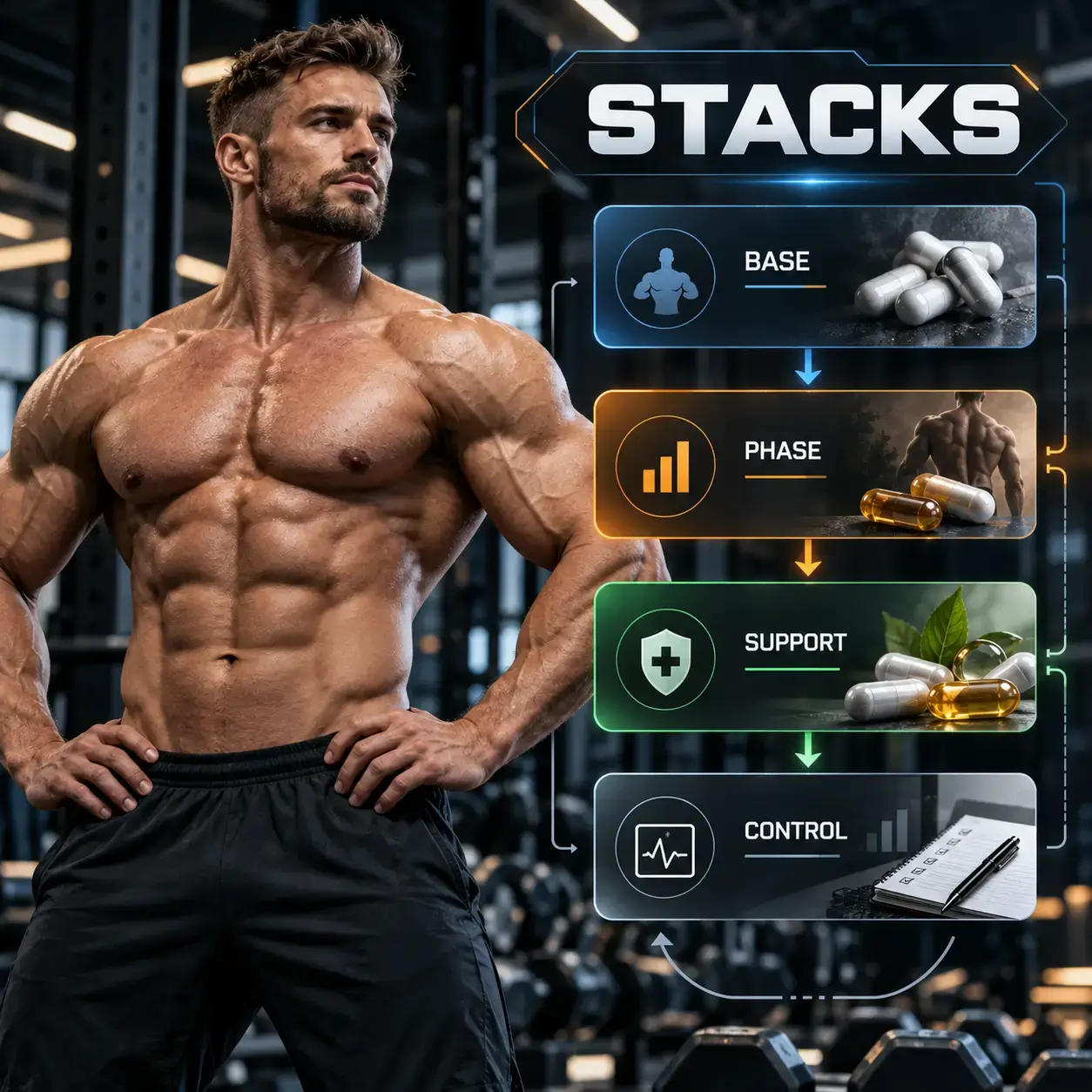
In bodybuilding, the difficult part is rarely simply adding another compound. The much harder question is why that compound is needed in a particular stack and what will actually change once it is added.
One athlete builds a cycle around gaining muscle mass. Another is trying to preserve muscle during an aggressive cutting phase. A third is already close to competition and is working less on overall size and more on the visual quality of the physique. The logic behind combining compounds will be different in each of these situations.
More components do not automatically mean better results. Every additional compound adds not only a potential effect, but also its own influence on hormonal balance, lipids, blood pressure, hematocrit, the liver and other health markers.
A well-structured stack therefore does not begin with a list of popular compounds. It begins with a simple question: what specific purpose does each component serve?
Core principles for building a cycle with multiple compounds
Most anabolic-androgenic steroids share a common foundation of action through the androgen receptor. That does not make them identical.
Compounds differ in several important ways:
- their anabolic and androgenic profile;
- their ability to aromatize into estrogens;
- their effect on the lipid profile;
- their impact on the liver;
- their progestogenic activity;
- their release rate and duration of action;
- their influence on the visual quality of the physique at low body-fat levels.
These differences are exactly why athletes combine different compounds in the first place.
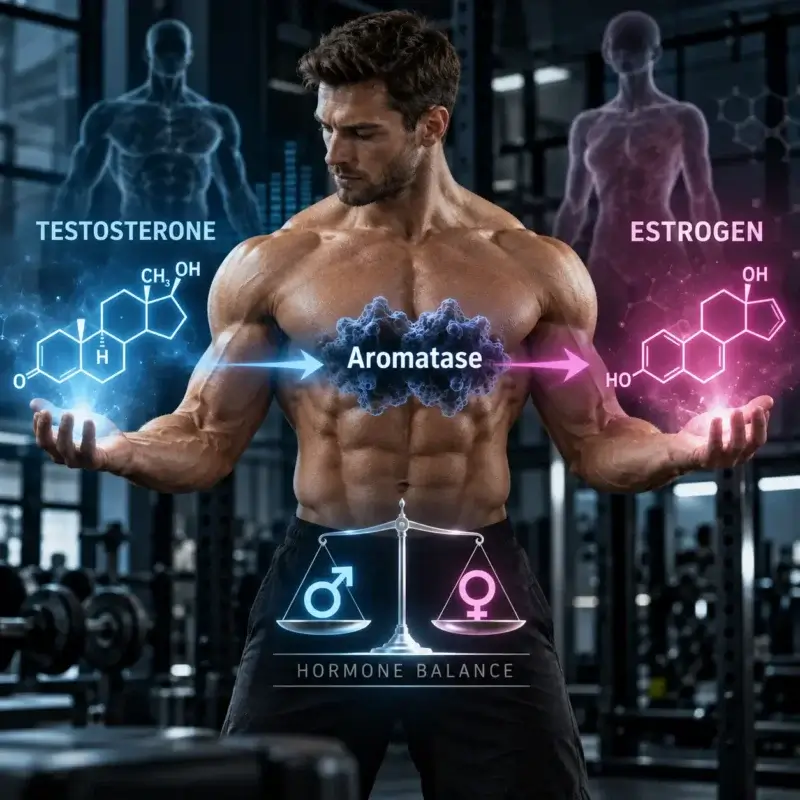
Testosterone, for example, provides a strong anabolic and androgenic foundation but can aromatize. Drostanolone does not aromatize and is more commonly discussed in the context of cutting and contest preparation. Nandrolone has a different hormonal profile, including progestogenic activity. Oxandrolone is an oral AAS with its own pattern of effects on the liver and lipid profile.
One compound does not automatically “fix” another. Adding a non-aromatizing compound to a stack does not eliminate the aromatization of Testosterone. A second anabolic compound does not neutralize the side effects of the first either.
The practical logic is simple: if a compound has no clear function within a specific goal, its place in the stack should be questioned.
How cycle duration relates to esters and dosage form
When building a multi-compound cycle, it is important to consider not only the compounds themselves, but also how quickly they act.
Long esters such as Testosterone Enanthate and Cypionate, Nandrolone Decanoate or Boldenone Undecylenate take longer to reach a stable concentration. In bodybuilding practice, these compounds are therefore more commonly seen in longer cycles, often starting at around 10–12 weeks.
Short esters and oral compounds produce faster changes. Testosterone Propionate, Drostanolone Propionate, Stanozolol and other fast-acting compounds are often used over shorter phases, for example around 6–8 weeks.
With oral AAS, there is an additional factor: duration is limited not only by how quickly the compound acts, but also by its effect on the lipid profile and, in the case of 17-alpha-alkylated compounds, by liver stress as well.
These ranges are not universal rules for every cycle. They are better understood as a reflection of the general pharmacokinetic logic: a long ester needs more time for its profile to fully develop, while a short ester allows exposure to begin and end more quickly.
How combining compounds affects effectiveness and side effects
The main advantage of a multi-compound approach is obvious: the athlete receives the effects of several compounds at the same time.
This is also where it becomes easy to fall into a trap. Online discussions often make it sound as if one compound is responsible only for size, another only for definition, and a third only for preserving muscle. The body does not divide responsibilities between compounds that neatly.
Using several AAS at the same time can:
- increase anabolic stimulation;
- suppress the body’s own hormonal axis;
- worsen the HDL-to-LDL ratio;
- affect blood pressure;
- increase hematocrit;
- intensify androgenic side effects.
Adding a second compound can genuinely change the outcome, but the entire setup becomes more complex at the same time.
A simple example: estradiol rises while using one compound. After adding a second, the lipid profile worsens. Then blood pressure begins to increase. If the stack already contains four or five active compounds, it becomes much more difficult to determine which component made the greatest contribution to a particular problem.
A clear, understandable stack is almost always better than a chaotic one. Not because there is some magic “correct number” of compounds, but because every additional component reduces the predictability of the entire setup.
Stacks for beginners: simplicity, control and risk reduction
A beginner has one major problem that an experienced user no longer has to the same extent: they do not yet know how their body responds to specific compounds.
How will estradiol change? How much will HDL fall? Will there be significant water retention? How will the skin react? What will happen to blood pressure and hematocrit?
If several new compounds are introduced for the first time at the same time, the answers to these questions become far less obvious.
For a first experience, a simple principle is useful: the fewer unknown variables introduced at the same time, the easier it is to assess the body’s response.
This does not mean that there is such a thing as a completely safe “beginner cycle.” The point is controllability. If a side effect appears while using one main compound, identifying the likely cause is easier than when several AAS, oral compounds, stimulants and additional support drugs are being used together.
Example of a ready-made beginner stack
As an example of how a ready-made combination can be built around one specific goal, the Beginner Bulking Stack can be considered.
The value of this example is not only in the set itself. It also demonstrates the structure behind the stack: there is a main compound for anabolic support, a separate compound with a different profile of action, and another product related to the post-cycle stage.
It is more useful to view such an example as a ready-made structure for a specific goal rather than as a universal template for every athlete.
DEUS MEDICAL
BULKING STACK for Beginners
SARMs are a separate topic. Beginners often choose them precisely because the word “selective” is almost interpreted as a synonym for “safe.” That is incorrect. SARMs can also suppress endogenous Testosterone, alter the lipid profile and produce other systemic effects.
The same principle of simplicity applies here as well: using five different SARMs at once does not make the outcome more predictable simply because they are not classified as traditional steroids.
Stacks for gaining muscle mass
During a bulking phase, the goal is usually straightforward: create a pronounced anabolic environment and maintain conditions that support muscle growth.
Testosterone is commonly found in such setups. The reason is clear: it is a well-studied androgen with a pronounced effect on lean body mass and strength performance.
The main question then becomes: why add a second compound?
Nandrolone in bulking stacks
Nandrolone is used as an additional anabolic compound with a profile different from Testosterone. It is associated with supporting gains in lean body mass, but at the same time its suppression of the endogenous hormonal axis, its effect on lipids and its progestogenic activity also need to be considered.
The best-known long-ester form is Nandrolone Decanoate. Because of the long ester, such setups are generally not viewed as short cycles. Time is needed to assess a stable effect, which is why in bodybuilding practice these cycles often fall into the 10–12 week range or longer.

The logic “Testosterone + Nandrolone = simply more mass” is too simplistic. Adding Nandrolone increases the overall anabolic load, but it also introduces new hormonal variables.
Boldenone in bulking stacks
Boldenone also appears in bulking-oriented setups. It is generally associated with gradual gains in lean body mass and strength performance.
Most often, this refers to the long-ester form Boldenone Undecylenate. Boldenone does not fit well into the idea of a short cycle: its concentration changes gradually, and the overall period of exposure is usually prolonged.

With Boldenone, monitoring red blood cell-related markers is particularly relevant. If an athlete adds it to another AAS, looking only at body weight and strength is clearly not enough. Hematocrit and blood pressure become equally important parameters.
This illustrates a sound principle of stack design very clearly: a second component should be evaluated not only by what it may add to the result, but also by which new parameter will need to be monitored.
Why more compounds do not guarantee more muscle
An increase in pharmacological load does not produce an endlessly linear increase in results.
If an athlete is not eating enough, sleeping poorly or following a training program that no longer provides an adequate stimulus, adding another compound does not correct those problems. Its impact on blood pressure, lipids and the hormonal axis, however, may still increase.
A good bulking stack is defined not by the number of compound names in it, but by how clearly the role of each component is understood.
Stacks for cutting, definition and preserving muscle mass
During a cutting phase, the logic changes. The main goal is no longer to maximize body weight, but to preserve muscle tissue during a calorie deficit and improve the visual quality of the physique.
The concepts of a “dry compound” and a “fat burner” are often confused.
If a compound does not aromatize and does not cause pronounced estrogen-dependent water retention, that can indeed have a positive effect on appearance. But it does not create a calorie deficit and does not make an athlete leaner by itself.
Drostanolone
Drostanolone is especially well known in the context of the later stages of contest preparation. It does not aromatize and has a pronounced androgenic profile.
Its visual characteristics become genuinely noticeable mainly when the level of subcutaneous body fat is already sufficiently low. If an athlete is still far from contest condition, expecting a pronounced “dry” appearance from the compound alone does not make sense.
The ester also matters here. Drostanolone Propionate is a short-ester form and is more commonly used during shorter phases of preparation, roughly around 6–8 weeks. Drostanolone Enanthate acts for longer and fits more naturally into longer setups.


This does not make one ester a “cutting ester” and the other a “bulking ester.” The main characteristics come from Drostanolone itself; the ester primarily changes the rate of release.
Stanozolol
Stanozolol is also commonly associated with cutting and a harder visual appearance of the musculature. It does not aromatize, but that does not make it neutral from a health perspective.
The compound acts significantly faster than long injectable esters, which is why in bodybuilding practice it is more often used over limited periods, commonly around 6–8 weeks.
One of the main trade-offs is its pronounced effect on the lipid profile. With the oral form, liver stress is also relevant. The idea that “if a compound works quickly, it can simply be used for longer” is not a sound one.

Oxandrolone
Oxandrolone is often considered an oral AAS with a more moderate androgenic profile. During cutting, it is generally associated with supporting muscle retention and strength performance without aromatizing itself.
Like other oral forms, it does not require the prolonged accumulation associated with a long ester. Its effects develop more quickly, so compounds of this type are more often used as a separate phase within a longer overall setup rather than necessarily throughout the entire cycle.
“Mild” in bodybuilding slang does not mean harmless. Effects on lipids and liver markers remain relevant.

Example of a ready-made cutting stack
Dinespower offers a Cutting Stack for Advanced Athletes. It combines several compounds with different pharmacological properties, aimed at a phase of reducing body-fat percentage while preserving the physique.
This example clearly shows why an advanced stack becomes more complex. Within one setup, it becomes necessary to account for the aromatization of one compound, the androgenic profile of another, the effect of an oral AAS on lipids and the overall burden created by the entire combination.
DEUS MEDICAL
CUTTING STACK for Advanced
Body fat still decreases because of an energy deficit. Pharmacology can influence the conditions for preserving muscle or the visual appearance of the physique, but it does not replace the foundation of cutting.
Health monitoring and bloodwork when using multiple compounds
The more complex a stack becomes, the less useful the approach “I’ll check total Testosterone and see whether everything is fine” becomes.
When several AAS are used at the same time, multiple body systems need to be assessed together.
Attention is commonly given to:
- complete blood count, hemoglobin and hematocrit;
- lipid profile;
- ALT, AST and other liver markers;
- blood pressure;
- estradiol and other hormonal markers depending on the situation;
- kidney-function markers in the context of the overall clinical picture.
Bloodwork does not function like a vehicle inspection that ends with a stamp saying “everything is safe.”
Normal ALT and AST values say nothing about the condition of the heart. High total Testosterone while using an exogenous compound does not show how strongly the endogenous hormonal axis is suppressed. Normal estradiol does not compensate for worsening HDL or rising blood pressure.
Another practical problem with multi-compound stacks is that changes rarely occur one at a time. If hematocrit rises, blood pressure increases, lipids worsen and the hormonal profile changes at the same time, focusing on only one marker makes little sense.
What happens after the stack ends
After AAS are discontinued, the task changes. The focus shifts to the dynamics of the endogenous hormonal axis, overall well-being and the recovery of markers that changed during the cycle.
The final administration does not always mean the end of pharmacological exposure. After long esters such as Enanthate, Cypionate, Decanoate or Undecylenate, active compounds can remain in the body for some time. The post-cycle period therefore cannot be assessed in the same way as after a fast-acting oral compound or a short ester.
Dinespower offers a Recovery Stack designed for the post-cycle stage.
Such a set can be viewed as an example of a ready-made combination for the recovery period. The presence of PCT-related components does not guarantee restoration of endogenous Testosterone production. The response of the HPG axis after AAS differs considerably between individuals.

Common mistakes when building sports-pharmacology stacks
Most problems with stacks do not arise because an athlete is unaware of some secret combination. The usual mistakes are much more straightforward.
Too many components at once
Five compounds do not only provide five potential effects. They also create five additional sources of unwanted reactions.
When a problem appears, the guessing begins: is Testosterone responsible, the second AAS, the oral compound, the stimulant, or the drug that was added later to control a side effect?
The more complex the setup, the harder it becomes to understand the body’s own response.
Adding one compound to correct the side effect of another
A very common sequence tends to look roughly the same.
Estradiol rises, so an aromatase inhibitor is added. Another symptom appears, so another product is introduced. Then a third drug is needed to control the consequences of the second.
In some cases, pharmacological correction can genuinely be justified. The problem begins when the stack grows automatically while the original cause is never reconsidered.
Overlapping risks
Two compounds can appear completely different in terms of their intended use while negatively affecting the same health marker.
For example, combining several compounds that adversely affect HDL and LDL can substantially worsen the lipid profile. Several androgens increase total androgenic load. Several oral 17-alpha-alkylated AAS add further liver-related burden.
Compatibility is therefore not simply a question of whether “compound A can be used together with compound B.” It is much more important to understand which risks overlap.
Ignoring pharmacokinetics
Another common mistake is evaluating every compound on the same timeline.
An athlete may expect the full effect of a long ester too early or, in the opposite situation, assume the cycle is over immediately after the final administration even though active compound is still continuing to enter the bloodstream.
Changes occur faster with short esters and oral compounds. With long esters, both the accumulation period and the gradual decline in concentration need to be taken into account.
Copying someone else’s stack
The fact that a particular setup works well for another athlete says very little about how an individual body will respond.
People differ in body-fat percentage, aromatase activity, baseline lipid profile, blood pressure, hematocrit, androgen sensitivity and the speed at which the hormonal axis recovers.
Someone else’s stack can be useful as an example of the underlying logic, but not as a ready-made template for another body.
Trying to solve a training problem with pharmacology
If body mass is not increasing because calorie intake is insufficient, adding another compound does not fix nutrition. If an athlete is recovering poorly because of inadequate sleep or excessive training volume, increasing the number of AAS does not turn a poor training program into a good one.
It sounds obvious, but this is often exactly the logic behind moving on to the “next stronger stack.”
Automatic PCT based on a template
Another mistake is assuming that one universal recovery protocol exists after every possible combination.
The degree of hormonal-axis suppression depends on the composition of the stack, the esters used, the duration of exposure and the individual response. The post-cycle state is better assessed from the actual hormonal picture rather than from a pre-saved template alone.
Combining compounds in bodybuilding: key takeaways
Stacks did not appear in bodybuilding by accident. Different compounds genuinely have different pharmacological properties, and combining them can change the nature of the anabolic effect, the visual appearance of the physique and the ability to preserve muscle mass under different conditions.
But a good stack is not defined by the number of components.
During a bulking phase, it is important to understand why Nandrolone, Boldenone or another compound is added alongside the base androgen. During cutting, it is necessary to distinguish between preserving muscle tissue, avoiding aromatization and directly reducing body fat. These are different processes.
Duration also cannot be considered separately from cycle composition. Long esters generally require a longer period, often around 10–12 weeks or more, while short forms and some oral compounds are more commonly used over phases of roughly 6–8 weeks. Longer does not automatically mean more effective.
For a beginner, the main value of a simple setup lies in controllability. For an experienced athlete, a complex stack requires more than simply knowing compound names; it requires understanding how their effects and risks overlap.
The main practical question when adding a new component is not “will it make the cycle stronger?” but “what exactly will it add to the result, how much time does it need to work, and what will need to be monitored additionally?”
If those questions have clear answers, the stack has a logical structure. If they do not, the additional compound is more likely to complicate the setup than to meaningfully improve it.