Deutsch
 English
 Français
 Español
 Italiano
 Svenska
 Čeština
 Nederlands
 Русский
 Українська
 Polski



Achieving peak condition by the time of the competition requires a bodybuilder to have a carefully structured action plan and extremely precise control over physiological processes. On the final stretch of preparation for a tournament, the athlete must demonstrate maximum endurance: bodybuilding shifts into the realm of strict self-discipline for the sake of a flawless result on stage.
How the general stage-ready plan is built during preparation for bodybuilding competitions
The foundation of future success in bodybuilding is built on the athlete’s ability to shift the body’s work in time from accumulating resources to using them at maximum capacity. In a competitive environment, an athlete’s professional level is determined not only by muscle size, but also by the ability to notice even the slightest water retention or slowdown in metabolism. This allows the training intensity to be adjusted in time without allowing muscle tissue to “burn out”.
A properly structured plan is always based on gradual progression so that the central nervous system does not fail too early. The main task here is to maintain muscle density while steadily reducing the energy value of the diet. Proper preparation means that the bodybuilder carefully analyzes the body’s response to every manipulation with carbohydrates. The process of bringing the physique to the ideal condition is based on the following principles:
- systematic reduction of calories for stable fat loss without a sharp drop in strength indicators;
- increasing the amount of work in the gym by reducing rest periods between sets and adding cardio sessions;
- weekly photo tracking and analysis of vascularity for objective adjustment of diet and physical workload.
A consistent sequence of actions helps avoid psychological exhaustion and maintain drive until the start of the competition. A carefully developed strategy allows the athlete to approach the tournament without chaotic changes in nutrition. Ultimately, proper preparation provides exactly that depth and hardness of muscle definition that judges value at qualifying bodybuilding tournaments. After all, real competitions are a demonstration of the superiority of discipline over physiological limitations.
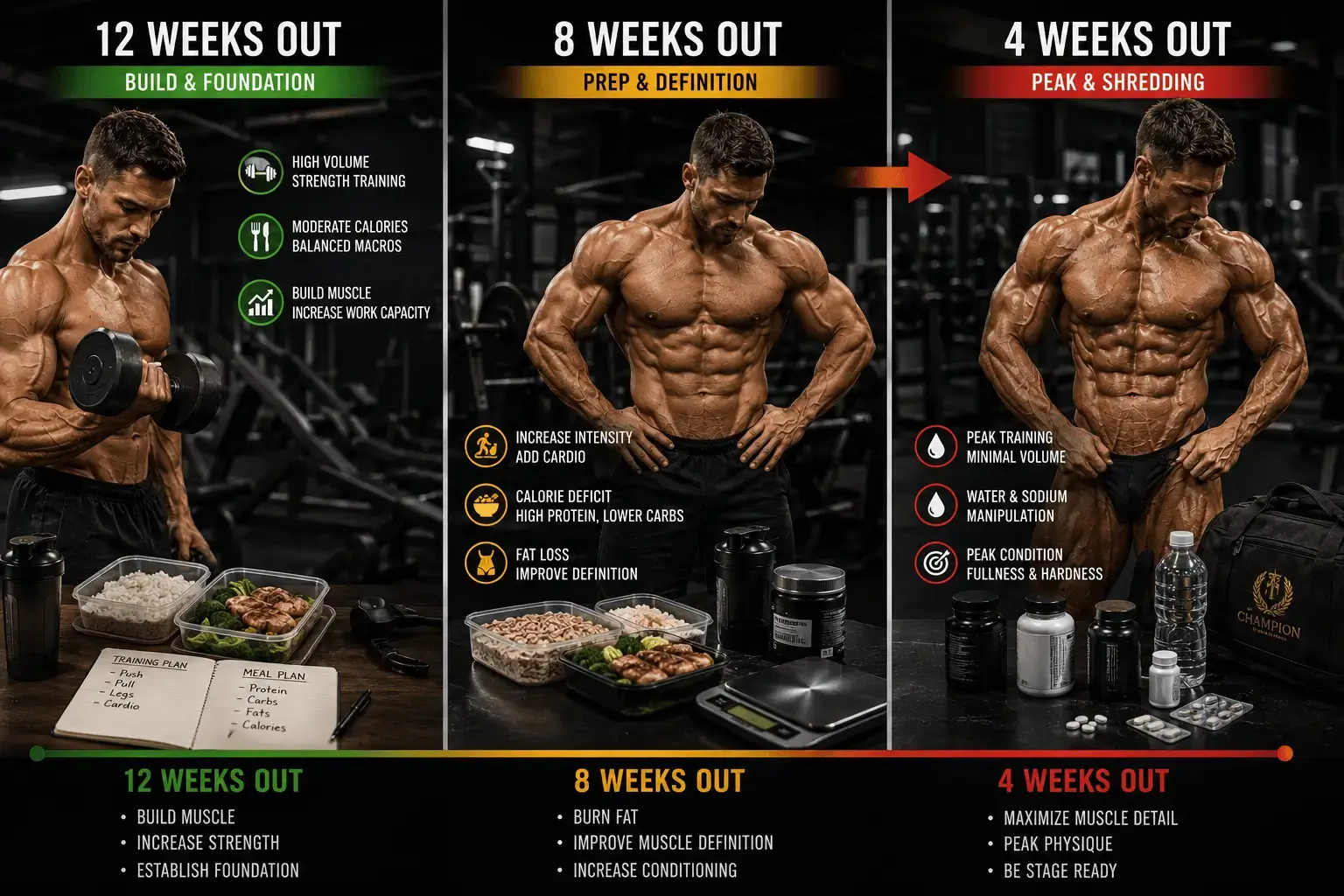
Stages of competition preparation: key changes 12, 8, and 4 weeks before the show
Twelve weeks before the start of the competition, the bodybuilder’s main task is to accelerate metabolism and begin a gradual diet. During this period, the athlete still works with heavy weights, but already begins to carefully calculate proteins, fats, and carbohydrates. This stage is important for creating the foundation on which future definition and depth of muscle separation will be built.
When eight weeks remain before the desired date, the workload becomes more specific and exhausting. Preparation moves into the phase of active fat burning, and cardio sessions may take up to an hour daily. There is practically no room left in the diet for simple carbohydrates, while the athlete’s overall well-being requires special willpower and mental endurance. The following changes in the routine are typical for this period:
- implementation of load periodization to prevent the body from adapting to monotonous training stimuli;
- transition to more frequent meals to maintain stable blood sugar levels;
- increased attention to the water-salt balance to improve the quality of the skin and overall visual condition.
One month before stepping on stage, the bodybuilder enters the most difficult phase, when fatigue becomes a constant companion. At this point, a professional approach requires extremely precise work with the physique, because even an extra hundred grams of water can hide the result of months of effort.
The final stage of preparation requires exceptional discipline and the ability to ignore hunger. Every workout during this period is aimed at maximizing glycogen depletion before the upcoming carbohydrate loading, which is necessary to give the muscles extreme volume and density directly on the day of the tournament.
Bodybuilding preparation strategy: training, nutrition, and pharmacology
Success on the podium depends on how harmoniously the athlete synchronizes training loads, diet, and recovery procedures. The training process during cutting is fundamentally different from mass-gaining work because of the increased pace and the use of supersets. The bodybuilder strives to fill the muscles with blood as much as possible, working on definition and vascularity even under conditions of a calorie deficit.
Nutrition at this time turns into a purely functional process, where the main task is to control body weight without losing tissue density. The focus is placed on easily digestible protein and complex carbohydrates, the amount of which is gradually reduced toward the end of each week. Supportive products also play an important role, helping maintain hard competitive condition:
- the use of thermogenics is necessary for additional calorie expenditure at rest;
- the use of specific esters is important for maintaining muscle hardness and fullness;
- support for the liver and kidneys helps reduce the increased load on the excretory system.
Proper construction of the training strategy eliminates unjustified health risks for the sake of a short-term effect. All manipulations must have a clear logical basis and correspond to the athlete’s current health condition. Only if preparation is carried out under the supervision of specialists can one count on longevity in the sport. The ultimate goal of the athlete is to show the maximum that the human body is capable of.
Condition control before competition: body fat percentage, water, and visual muscle quality
Closer to the final stage, the bodybuilder analyzes their reflection in the mirror every day, paying attention to quadriceps separation and the depth of the abdominal muscles. If the condition is behind schedule, the athlete may resort to short-term protein-fat phases to speed up the process.
Constant control of the subcutaneous water level allows the athlete to understand how successfully the approach to peak condition is progressing. The main indicators at this stage include:
- the thickness of the skinfold, which should be minimal across the entire body;
- the presence of a clear muscle pattern even in a relaxed state;
- overall muscle fullness, indicating proper carbohydrate loading.
Strict control of the diet at the finish line helps avoid swelling caused by insulin spikes. The athlete must know exactly when to stop or significantly reduce water intake so that the physique becomes “glass-like”. This stage of preparation is the most dangerous and requires enormous experience.
Proper stage preparation: how to avoid mistakes and keep your condition until the show
Many promising athletes lose their chances of victory because of incorrect actions during the last 24 hours before stepping onto the podium. Proper dosing of salt and water on the day of the tournament can transform the muscles, making them voluminous and hard. However, excessive use of diuretics often leads to cramps that prevent the athlete from posing properly in front of the judges.
When the competition begins, it is important to remain calm and confident in the work already done. To make the performance go smoothly, a professional athlete chooses high-quality tanning product in advance, one that will emphasize definition under bright stage lights, and practices posing without hesitation, pauses, or mistakes.
Such preparation in bodybuilding reduces the risk of force majeure situations at the most responsible moment. A flawless physique is always the result of a system, not a coincidence.
High-quality sports pharmacology products for each stage
Professional bodybuilding is a discipline that requires the integration of medicine and sport. The choice of supportive products in this sport depends on which exact stage of professional preparation the athlete is going through. Each period before competition has its own tasks, and the corresponding products help solve them:
- products for maintaining high levels of free testosterone during a low-calorie diet;
- products that improve fatty acid transport, accelerate the cutting process, and protect protein structures from breakdown;
- substances for the final “polishing” phase, providing extreme vascularity and density.
At the preparation stage 12 weeks before the competition, athletes often focus on gaining or preserving muscle mass, using solutions such as Testosterone Enanthate, Testosterone Cypionate, RAD-140 (Testolone), and LGD-4033 (Ligandrol).
8 weeks before stepping on stage, when active fat burning and preservation of dry mass become the priority, GW-501516 (Cardarine), SR-9009 (Stenabolic), MK-677 (Ibutamoren), and recovery support complexes are in demand.
At the final stage of preparation, 4 weeks before the competition, special attention is paid to water control, muscle hardness, and the quality of the physique. For these tasks, athletes often use Testosterone Propionate, Drostanolone Propionate, as well as specialized complexes such as ECA and Clenbuterol, which help emphasize definition and improve the visual quality of the muscles.
Constant control of product dosages guarantees the achievement of bodybuilding goals without unnecessary harm to the body. A professional approach involves using only certified products with predictable effects. A properly built preparation plan with control over all processes allows the athlete to show the maximum of their genetic potential.