Deutsch
 English
 Français
 Español
 Italiano
 Svenska
 Čeština
 Nederlands
 Русский
 Українська
 Polski



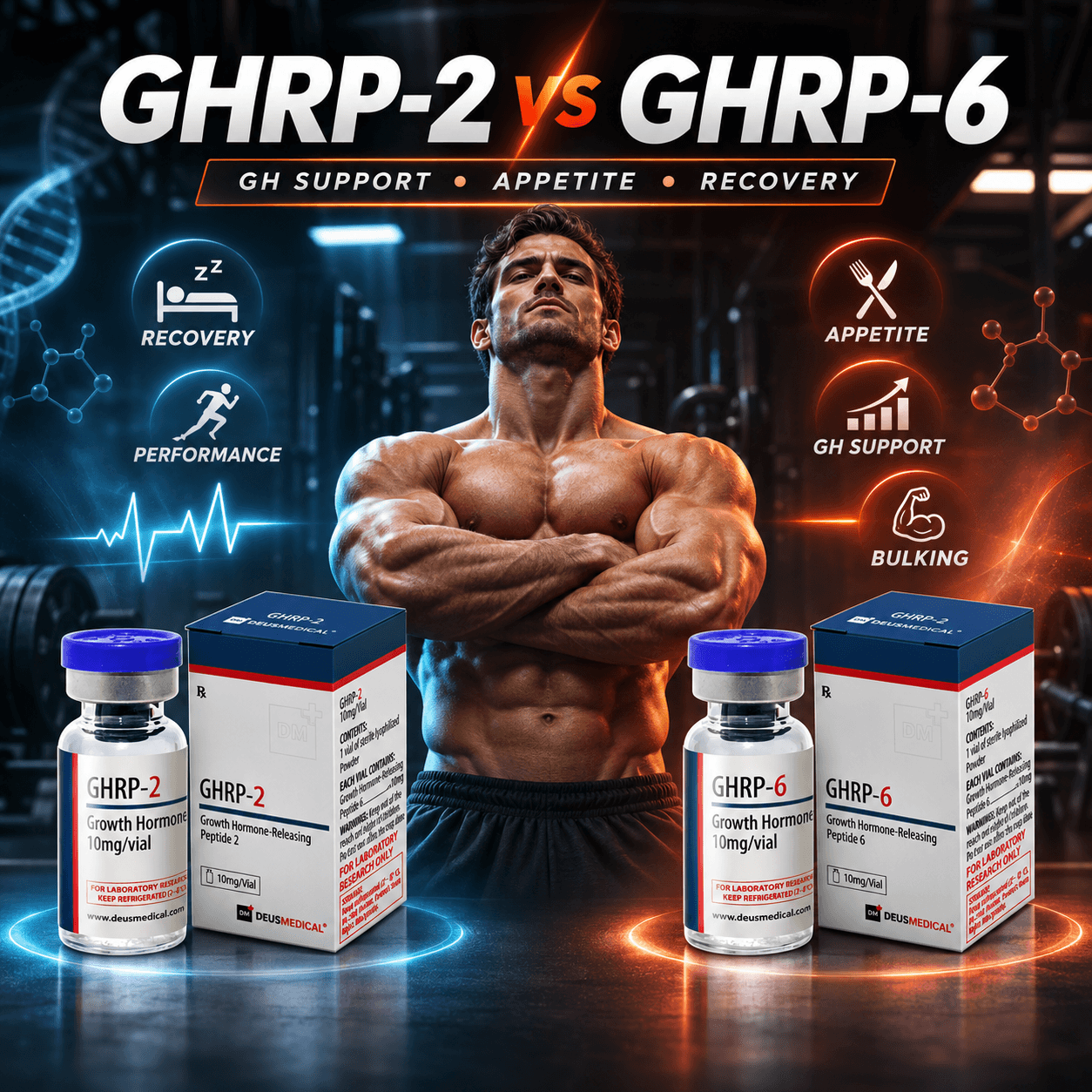
GHRP-2 and GHRP-6 belong to the group of growth hormone secretagogue peptides. In bodybuilding, they are used with the aim of increasing endogenous GH pulses, supporting recovery and influencing body composition.
Both peptides act through the ghrelin receptor GHS-R1a, so their mechanisms are similar in many respects. The differences become more noticeable in practical use: in their effect on appetite, additional hormonal effects and how well each option fits a specific goal.
GHRP-2: What Is This Peptide and How Does It Stimulate Growth Hormone?
GHRP-2 belongs to the group of Growth Hormone Releasing Peptides – peptides that stimulate the secretion of endogenous growth hormone. It binds to the GHS-R1a receptor and triggers a short-term release of GH.
This mechanism differs from administering ready-made somatropin. GHRP-2 does not replace endogenous growth hormone but stimulates the body to secrete it, so the effect has a pulsatile character.
Endogenous GHRH also plays an important role – the hormone involved in the natural regulation of GH release. In studies, combining GHRP-2 with GHRH produced a more pronounced response than using either signal alone.
In human studies, GHRP-2 did in fact produce a noticeable increase in growth hormone secretion. However, as the dose increased, not only the GH response but also additional hormonal reactions increased, including prolactin, ACTH and cortisol.
GHRP-2 in Bodybuilding: Appetite, Recovery and Main Uses
In bodybuilding, GHRP-2 is used primarily with the aim of stimulating GH and supporting recovery processes. It may be included during bulking phases, in protocols focused on body composition or during periods of high training load.
Appetite may also increase. GHRP-2 acts through the ghrelin system, and human studies have shown increased food intake after its use. Therefore, it is not correct to consider it completely neutral in terms of hunger.
In practice, GHRP-2 is more often of interest to those for whom appetite stimulation is not the main goal of the cycle. If someone already finds it easy to consume the required number of calories, a strong drive to eat may be more of a disadvantage.
Recovery usually refers to the attempt to enhance physiological GH pulses and influence recovery processes between workouts through the GH/IGF-1 system. At the same time, GHRP-2 should not be viewed as a proven compound for accelerated healing of injuries, tendons or muscles.
GHRP-6: Mechanism of Action and Effect on Growth Hormone Secretion
GHRP-6 belongs to the same class of secretagogues and also activates the GHS-R1a receptor. As a result, endogenous growth hormone secretion increases.
As with GHRP-2, the response does not depend only on direct pituitary stimulation. In studies, blocking endogenous GHRH significantly reduced the GH response to GHRP-6, showing that several parts of the same hormonal system are involved.
The peptide acts for a relatively short period, so in sports practice it is usually used with the aim of producing repeated pulses rather than maintaining a constantly elevated growth hormone level throughout the day.
GHRP-6 in Bodybuilding: Appetite, Recovery and Practical Use
One of the most noticeable characteristics of GHRP-6 is a pronounced increase in appetite. This is exactly why the peptide is particularly often considered during bulking phases.
For an athlete who struggles to consume enough calories, becomes full quickly or finds it difficult to maintain a high food intake for several months, this effect may be useful. Eating becomes easier and maintaining a calorie surplus becomes less demanding.
On the other hand, if someone already tends to overeat easily or is trying to control fat gain, strong hunger becomes a limitation. This is especially noticeable during cutting, because maintaining a calorie deficit already requires strict control of food intake.
As far as recovery is concerned, the logic remains the same as with other GHRPs: the main interest is related to GH stimulation rather than a separate unique mechanism of GHRP-6.
GHRP-2 vs GHRP-6: Main Differences Between the Peptides
In terms of mechanism, GHRP-2 and GHRP-6 are similar: both are GHS-R1a agonists and stimulate the secretion of endogenous growth hormone. The main difference between them therefore lies not in fundamentally different pathways of action but in their effect profiles.
| Parameter | GHRP-2 | GHRP-6 |
| Class | GHRP, GHS-R1a agonist | GHRP, GHS-R1a agonist |
| Growth hormone stimulation | Pronounced | Pronounced |
| Appetite | May increase | Usually more pronounced |
| Additional hormonal effects | Possible stimulation of prolactin, ACTH and cortisol | Additional effects of the ghrelin system are also possible |
| Practical profile | More often chosen when the main interest is GH stimulation | More often chosen when a pronounced increase in appetite is desired together with GH stimulation |
Therefore, the question of GHRP-2 vs GHRP-6 is better viewed as a choice between different effect profiles rather than an attempt to determine a universally “stronger” peptide.
How GHRP-2 and GHRP-6 Are Used: Dosage, Frequency and Cycle Length
In sports practice, GHRP-2 and GHRP-6 protocols are similar in many respects. For both peptides, around 100–200 mcg per administration 2–3 times per day is often used, while cycle length is usually approximately 12–16 weeks.
An amount of around 100 mcg is sometimes referred to as a “saturation dose,” but this figure should not be treated as a strict physiological limit. The GH response depends on dose and individual sensitivity. With further increases in amount, any additional increase in growth hormone stimulation may be accompanied by more noticeable additional hormonal effects.
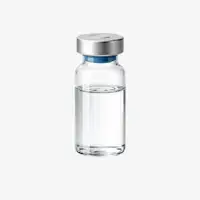
GHRP-2 by Deus Medical contains 10 mg of peptide per vial. In a practical protocol, this allows, for example, 100–200 mcg per administration several times throughout the day. With GHRP-2 in particular, there is little reason to increase the dose uncontrollably: along with the GH response, prolactin, ACTH and cortisol reactions may also become more pronounced.
DEUS MEDICAL
GHRP-2 Peptide in Vials
GHRP-6 by Deus Medical also contains 10 mg of the substance per vial and is used in a comparable range – approximately 100–200 mcg per administration 2–3 times per day. With this peptide, increasing the amount is particularly noticeable in terms of appetite, so a higher dose should not be viewed only as a way to achieve a stronger GH pulse.
DEUS MEDICAL
GHRP-6 Peptide in Vials
In sports protocols, common administration points include the morning after waking, the period after training and the time before sleep. This makes it possible to distribute separate pulses of growth hormone secretion throughout the day. Using all three points is not mandatory: frequency depends on the selected protocol and the total number of administrations.
Both products are supplied in lyophilized form and are reconstituted with bacteriostatic water before use. Since each vial contains 10 mg, it is better to calculate the solution concentration in advance according to the required number of micrograms so that each administration corresponds to a convenient volume.
Should GHRP Be Used on an Empty Stomach?
In sports practice, GHRP-2 and GHRP-6 are often used on an empty stomach or between meals. In particular, users often try not to combine administration with a large intake of carbohydrates and fats.
A common practical guideline is around two hours after the previous meal and approximately 30 minutes before the next one. This is a practical sports protocol rather than a mandatory clinical interval.
With GHRP-6, the rapidly developing hunger should also be taken into account. If the peptide is being used during a bulk specifically for this purpose, it makes sense to plan the next meal into the diet in advance rather than responding to sudden appetite with random foods.
GHRP-2 and GHRP-6 with GHRH Analogs
One of the most common combinations is the use of one GHRP together with a GHRH analog, for example MOD GRF 1-29.
The physiological logic is clear: GHRP activates the ghrelin receptor, while a GHRH analog acts on another part of the regulation of growth hormone secretion. In studies, simultaneous stimulation of these pathways produced a more pronounced GH response than using each signal separately.
For this reason, GHRP-2 + MOD GRF 1-29 or GHRP-6 + MOD GRF 1-29 are viewed as combinations of two complementary mechanisms rather than simply an increase in the amount of the same type of secretagogue.
GHRP-2 + GHRP-6 Together: Does It Make Sense?
A combined cycle of GHRP-2 and GHRP-6 has less physiological logic than combining one GHRP with a GHRH analog.
Both peptides act primarily through the same GHS-R1a receptor. Therefore, when used together, their mechanisms largely overlap, and a second GHRP does not add a fundamentally new pathway for growth hormone stimulation.
If the goal is to enhance the GH pulse, it is usually more logical to choose one of the GHRPs and add a GHRH analog. Using GHRP-2 and GHRP-6 together is more likely to increase overall stimulation of the same pathway than to create full synergy between two different mechanisms.
Side Effects and Limitations of GHRP-2 and GHRP-6
The side effects of GHRP-2 and GHRP-6 are related both to the ghrelin system and to increased GH signaling. Possible effects include pronounced hunger, water retention, tingling or numbness, headache and reactions at the injection site.
With prolonged stimulation of the GH/IGF-1 system, glucose metabolism is also relevant. Growth hormone can reduce insulin sensitivity, so these protocols require particular caution in people who already have impaired glycemic control.
GHRP-2 is specifically known to stimulate not only GH but also prolactin, ACTH and cortisol. This is one reason why a higher dose does not necessarily mean a more favorable balance between effects and adverse reactions.
GHRP-2 and GHRP-6 are not androgens, so women do not face the virilization risk characteristic of AAS. However, use in women is still associated with effects on GH/IGF-1, appetite, glucose metabolism and other endocrine processes, so the absence of androgenic activity does not make these peptides neutral.
GHRP-2 or GHRP-6: Which Is Better for Different Goals?
It is more practical to choose between GHRP-2 and GHRP-6 based on the specific goal rather than on which one is “stronger.”
| Goal | Which option is usually more logical? |
| Main interest is growth hormone stimulation | GHRP-2 |
| Bulking and difficulty maintaining a high calorie intake | GHRP-6 |
| Appetite is already high | More often GHRP-2 |
| A pronounced increase in hunger is desired | GHRP-6 |
| Cutting and strict calorie control | More often GHRP-2 |
| Enhancing the GH pulse | One GHRP + GHRH analog |
| Recovery after training | There is not enough basis to consider one option clearly superior to the other |
In practice, GHRP-6 has its clearest advantage when insufficient appetite becomes the limiting factor. GHRP-2 is more often chosen in situations where this effect is not needed or may interfere with dietary control.
Key Conclusions on GHRP-2 and GHRP-6
GHRP-2 and GHRP-6 belong to the same class of peptides and stimulate endogenous growth hormone pulses through the ghrelin receptor. Their differences are mainly related to the practical effect profile rather than completely different mechanisms.
Sports protocols often use around 100–200 mcg per administration 2–3 times per day for 12–16 weeks. Increasing the amount does not guarantee a proportional increase in the desired effect and may make additional hormonal reactions more pronounced.
For enhancing the GH response, a combination of one GHRP with a GHRH analog has a clearer physiological rationale. Using GHRP-2 and GHRP-6 together largely duplicates the same pathway, so choosing between them based on the goal of the cycle and individual tolerance is more rational.